Orchids and Memory: The Legacy of Daniel Weber
“...The life of a painter would not suffice to reproduce, even if confined to a small corner of the earth, the magnificent orchids….”
Alexander von Humboldt, Views of Nature
Orchids, exponents of the most diverse and dazzling family of flowering plants, have fascinated every mortal who has ever gazed upon them. Who could have imagined such a display of beauty and creativity—almost absurd—in a green being that grows suspended from trees?
This marvel of evolution continues to astonish us every day, especially at its epicenter of diversity: the tropics. For, after all, tropical forests may not have cathedrals, but they do have orchids—arches of perfume, petal-stained glass, and altars of nectar.
And, as Goethe might have intuited in the depths of his morphological vision:
“The orchid is a leaf that dreamed of becoming a butterfly… and succeeded.”
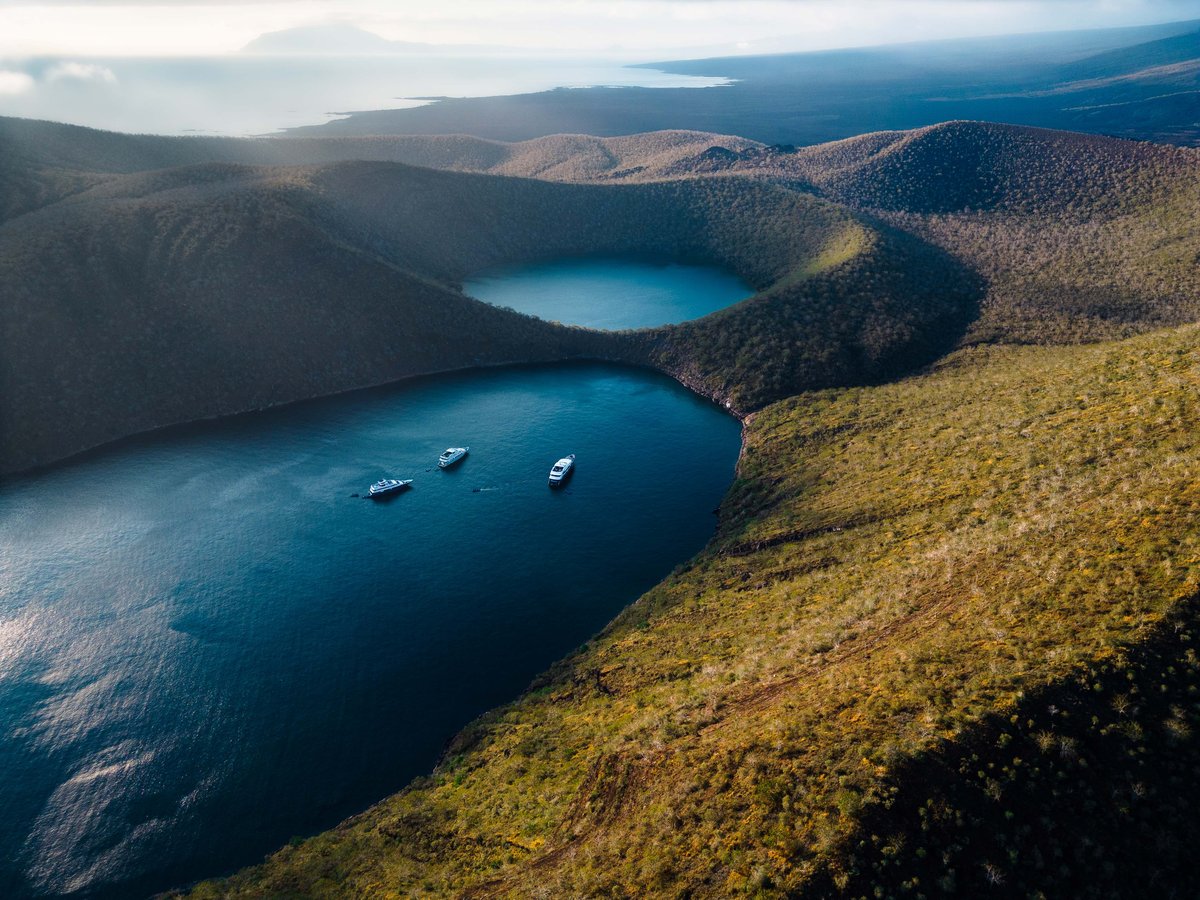
Yet more than a thousand kilometers away from those vast tropical rainforests, remote islands rise from the ocean, inhabited by some of the most singular beings shaped by evolution.
The Galápagos Islands—where Darwin himself found the cornerstones of his theory of natural selection—also shelter orchids in their most humid and silent corners. Small, discreet, sometimes invisible at first glance, yet so profoundly adapted that they fill the Scalesia forests, misty shrublands, and the most unexpected niches of this natural laboratory of evolution with life and mystery.
Years later, back in England and still astonished by the complexity of these plants, Darwin wrote to his colleague Asa Gray a sentence that captures the botanical perplexity that accompanied him throughout his life:
“I have been so struck with the contrivances of orchids… that I never saw anything so beautiful.” Charles Darwin, letter to Asa Gray, 1861
“I never dreamed that there was such wonderful beauty in the structural details of these flowers.” Charles Darwin, letter to Asa Gray, 1862
The beauty that captivated naturalists such as Humboldt, Goethe, and Darwin did not go unnoticed by Daniel Weber: Swiss by origin, an architect by profession, but a botanist at heart. He was not formally trained as a biologist, yet he was a meticulous observer and an extraordinary artist who, in addition to collecting plants, designed in 1968 the plans for at least three buildings at the Charles Darwin Research Station, including the emblematic Van Straelen Center and the iconic A-frame house.
With scarce resources, Weber traveled across the islands by joining other scientists’ expeditions, journeying as a “solidarity stowaway” aboard research vessels. His passions—architecture and botany—converged during those years of naturalist fervor, transforming his love for form, design, and plant life into a scientific and aesthetic legacy.
Juliana Puentes/CDF
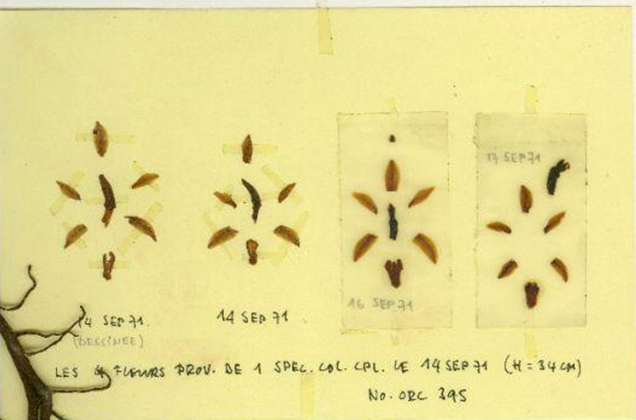
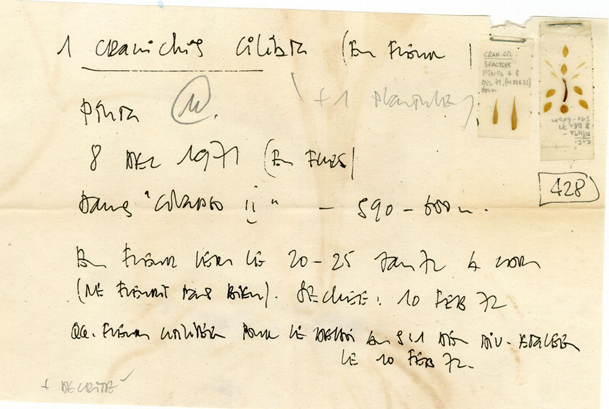
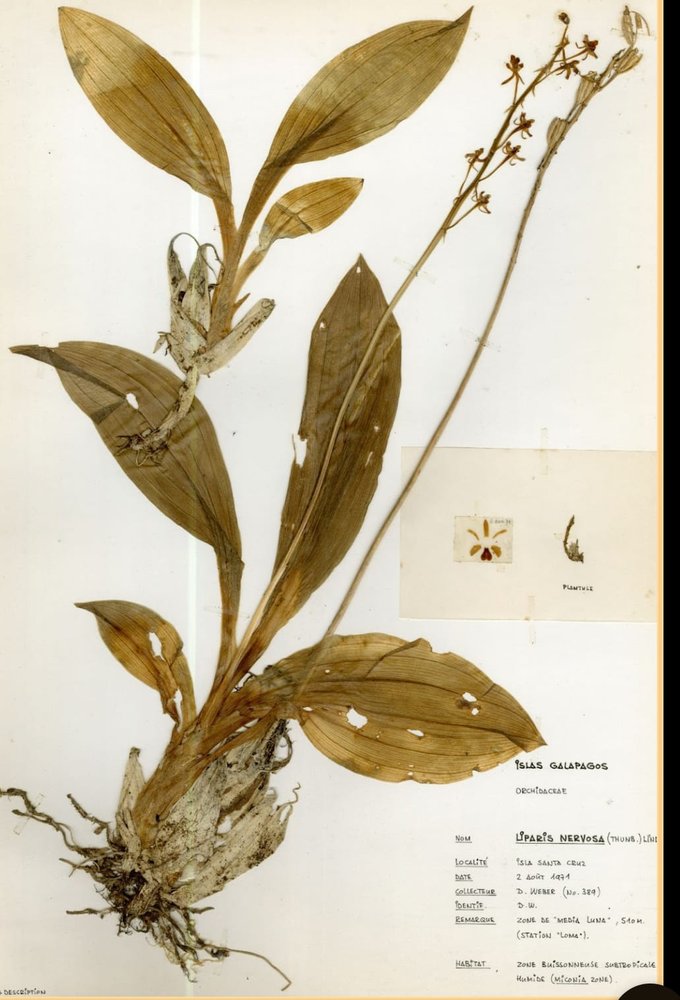
Between 1971 and 1972, Weber carried out several expeditions in the Galápagos, during which he collected approximately 180 orchid specimens, pressing and mounting them with meticulous care. Among these were species of the genera Epidendrum and Habenaria: Epidendrum spicatum, with its slender stems and tiny flowers, seems to defy the volcanic aridity; Habenaria monorrhiza, with its translucent petals, captures the light like a flash of dawn. Each specimen is accompanied by handwritten labels recording locality, dates, and taxonomic identification.
This small personal herbarium—imbued with fragility and wonder—traveled back with him to Switzerland at the end of 1973. There, among his belongings, it remained in silence for decades, protected from time, awaiting rediscovery.
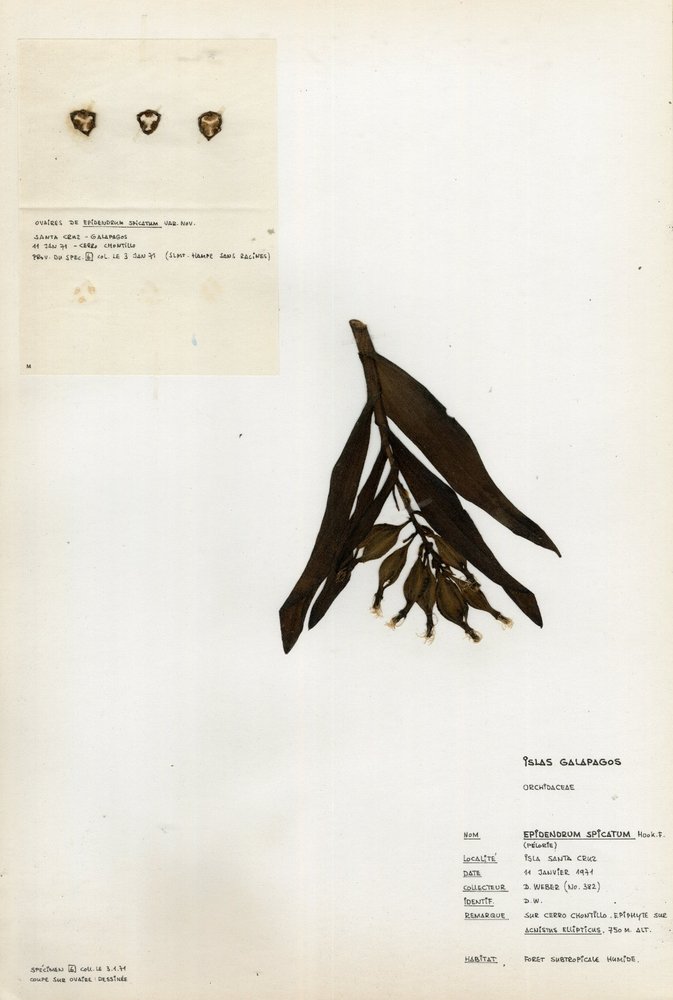
Juliana Puentes/CDF
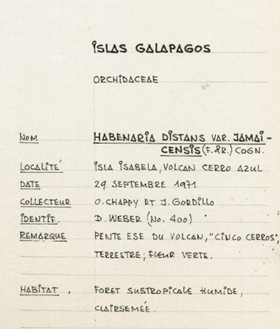
Juliana Puentes/CDF
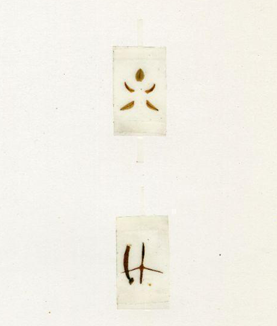
Juliana Puentes/CDF
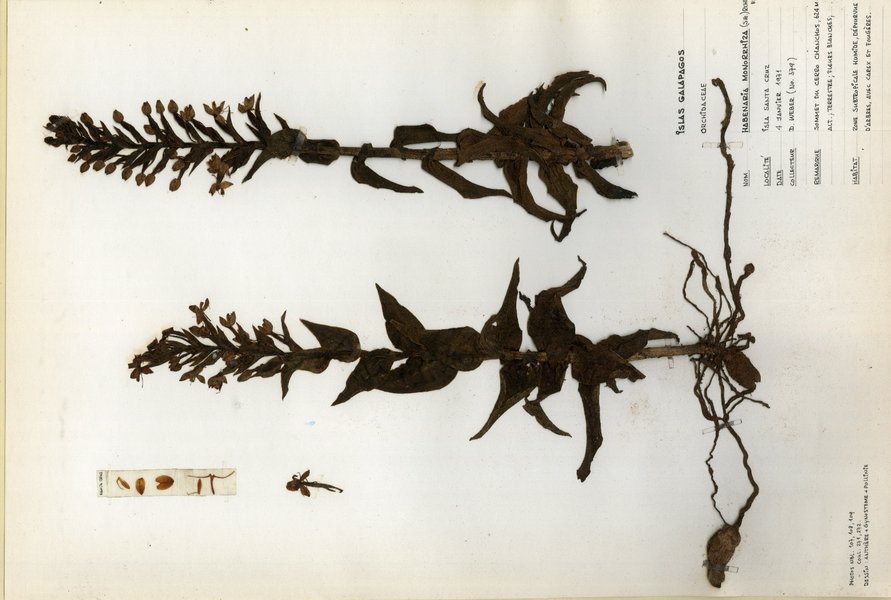
Juliana Puentes/CDF
Juliana Puentes/CDF
The Rescue of a Legacy
The story of these orchids involves not only the person who collected them, but also those who brought them back.
After his years in the Galápagos, Daniel Weber returned to Switzerland with his personal herbarium, photographs, drawings, and field notebooks. His passion for botany and architecture was recorded in every specimen, and the material remained intact in his basement. For years, Peter Kramer, former director of the Charles Darwin Research Station, sought to reestablish contact with Weber and began a meticulous search: he contacted every Daniel Weber in Switzerland, but none proved to be the person he was looking for. He then reached out to universities and numerous NGOs in French-speaking Switzerland, until he finally found someone at the NGO Pro Natura in Neuchâtel who had known Daniel.
There, Peter learned that Daniel had worked as a volunteer managing protected areas and that, unfortunately, he had passed away in 2019. Through this contact, Peter managed to communicate with Eric, Daniel’s brother, who explained that Daniel had lived a very private life, without telephone or electronic communication, and that they had only recently begun clearing out his basement.
Peter then mobilized his son David Kramer, who was living in Switzerland, to travel to Neuchâtel and collect all the material related to the Galápagos. Later, in 2021, Peter himself traveled to Switzerland, packed the entire collection, and shipped it from Moudon to Ecuador. The boxes containing documents, photographs, and notebooks arrived without incident, but the boxes with plant specimens were held up in the postal system, threatening to remain there indefinitely.
The joint effort to recover the lost specimens gained momentum in response to a clear gap in the natural history of the Galápagos. As Ecuadorian biologist Galo Jarrín explains, his interest in Weber’s specimens arose during the research for his book Orchids of the Galápagos. While searching for information at the Charles Darwin Research Station and across the archipelago, he found that there were virtually no extensive studies or collections of Galápagos orchids. In this process, he discovered the figure of Daniel Weber—whose specimens and documentation had not yet returned to the islands.
Galo contacted Peter Kramer, who confirmed that Weber had passed away and that the documents and specimens had been sent to the Galápagos. Peter expressed his willingness to help locate them once he learned that they had been shipped but were lost following the disappearance of Ecuador’s national postal service. In addition, Galo spoke with Cecilia Hernández, wife of Dutch ornithologist Tjitte de Vries, and told her about Daniel Weber’s collection and its possible loss within the postal system. That conversation sparked Cecilia’s characteristic determination: if the material existed and was lost, it had to be recovered.
Juliana Puentes/CDF
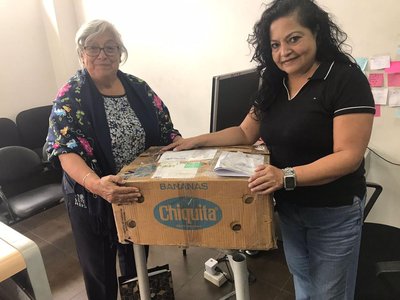
Cecilia immediately became involved and began tracking the boxes through warehouses and postal offices. Her efforts ultimately opened the path to their recovery. Thus, on the morning of June 27, 2024, Cecilia went to the Quito post office. Upon mentioning “Charles Darwin Research Station, Santa Cruz, Galápagos,” a local official located the tracking number: the package was in the Pusuquí office, marked for incineration because it had not been claimed.
Cecilia did not hesitate. She traveled there immediately, where she was told in astonishment: “You are very lucky… the package was not burned because the incinerator broke down.” The supervisor was called, and the order was given to remove all packages destined for the Galápagos from the incineration list. A path full of coincidences—as if the orchids themselves were weaving their way back.
With the support of the appropriate authorities, the necessary permits were obtained for the final leg of the orchids’ return journey. On October 6, 2024, after three years of a troubled voyage, these beautiful orchids arrived at the Natural History Collections of the Charles Darwin Foundation.
The specimens were examined, and their state of preservation was extraordinary: specimens in excellent condition, suitable for morphological and taxonomic analyses; field records of great value for long-term ecological change studies. Today, integrated into the Station’s herbarium, Daniel Weber’s orchids have bloomed again—not in the forest, but in scientific memory.
They are more than herbarium sheets: they are witnesses to the bond between science, beauty, and memory, and they will continue to inspire future generations of botanists. Thanks to this collective effort—above all that of Peter and Cecilia—the orchids that were once on the verge of being incinerated finally returned to their place of origin, not only as botanical specimens, but as living fragments of a story woven from science, determination, and memory.