

Silky Shark Tagging Study Reveals Gaps in Marine Protected Areas
The limited range of Marine Protected Areas (MPAs) offers reduced protection to vulnerable species such as the highly mobile silky shark (Carcharhinus falciformis). Threatened by commercial fisheries and the global fin trade, more research is needed to understand their movements and how to improve levels of protection, a new study has found.
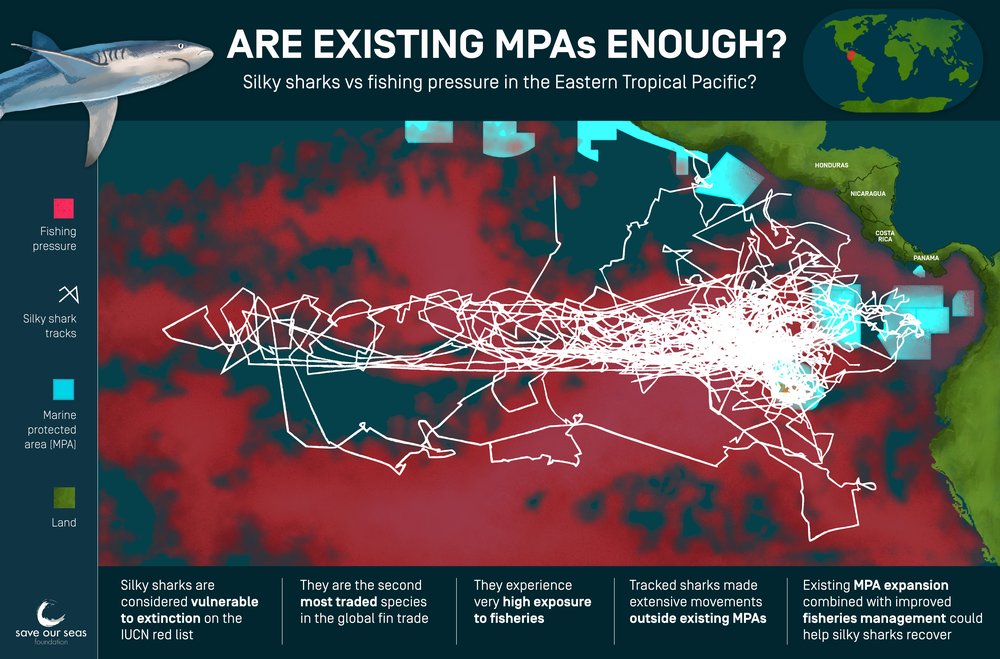
In the first assessment of its kind, the study, ‘Pelagic sharks in parks: Marine protected areas in the Eastern Tropical Pacific provide limited protection to silky sharks tracked from the Galapagos Marine Reserve’, found that while the species spent less than half their time within the 133,000 square kilometre Galápagos Marine Reserve (GMR), they were tracked outside the relative safety of the MPAs for over half of the study period.
Listed as ‘Vulnerable’ on the IUCN Red List of Threatened Species, global data has shown that overfishing has caused silky shark populations to decline by 47–54% in the last 30-40 years. Meanwhile, fins from silky sharks make up the second highest proportion, by species, impacted by the international fin trade.
As part of the international study, carried out by the Guy Harvey Research Institute, Save Our Seas Foundation Shark Research Centre, Charles Darwin Foundation, and the Galapagos National Park Directorate, a total of 40 silky sharks were tagged and their movements tracked by satellite technology over the course of nearly two years
Jeremy Vaudo, Ph.D, of the Guy Harvey Research Institute and Save our Seas Foundation Shark Research Centre at Nova Southeastern University, and lead author of the study, published in Biological Conservation, has called for more research into the movements of silky sharks in order to better protect this vulnerable species.
He said: “According to our research, silky sharks spent around half their time outside of MPAs and made little use of recently established ones designed to protect areas thought to be a movement corridor of large pelagic species, including sharks.
©Save Our Seas Foundation
“The study demonstrates that upon leaving the MPAs, they run the gauntlet of a range of threats including longline and purse-seine fisheries. They are among the most heavily fished shark species in the Eastern Tropical Pacific (ETP) ecoregion and not only are they a major victim of the global fin trade, but their tendency to spend time on the high seas outside of the regions MPAs also puts them at risk of being incidentally taken as bycatch by industrial fishing fleets.
“Our current level of understanding is so limited we don’t even know where silky sharks mate or give birth. It is, therefore, vitally important for the scientific community to gain a much deeper understanding of their movement patterns, and those of other species of concern, and for improved fisheries management, in order to make the best decisions on where to designate future areas as MPAs.“
For the study, 40 adult silky sharks, (33 females, seven males), which can grow up to 3.5m in length, were tagged with fin-mounted satellite tags. Ten were tagged in February 2021 off Darwin Island, with a further 30 tagged in July 2021 (14 off Darwin Island and 16 off Wolf Island). On average they spent nearly 47% of their time in the GMR with comparatively little time spent in the region’s other, recently established, MPAs to the east.
Silky sharks are a nomadic species known to travel vast distances in the high seas. In one instance, a record-breaking silky shark, tagged at Wolf Island in 2021, recorded 27,666 kilometres (17,190 miles) of ocean travel in less than two years.
According to Dr. Mahmood Shivji, co-author of the study and director of the Guy Harvey Research Institute and Save our Seas Foundation Shark Research Centre the study reveals both positive but also concerning discoveries regarding the effectiveness of the current MPAs in the region, many of which are situated to the east of the GMR.
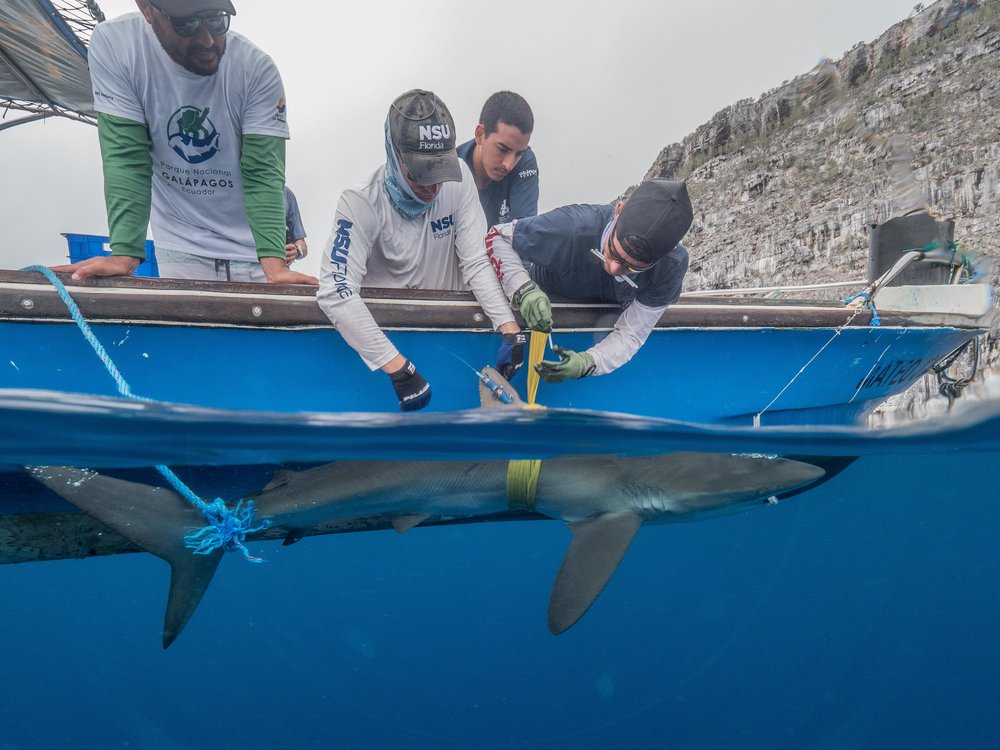
Pelayo Salinas de León/CDF
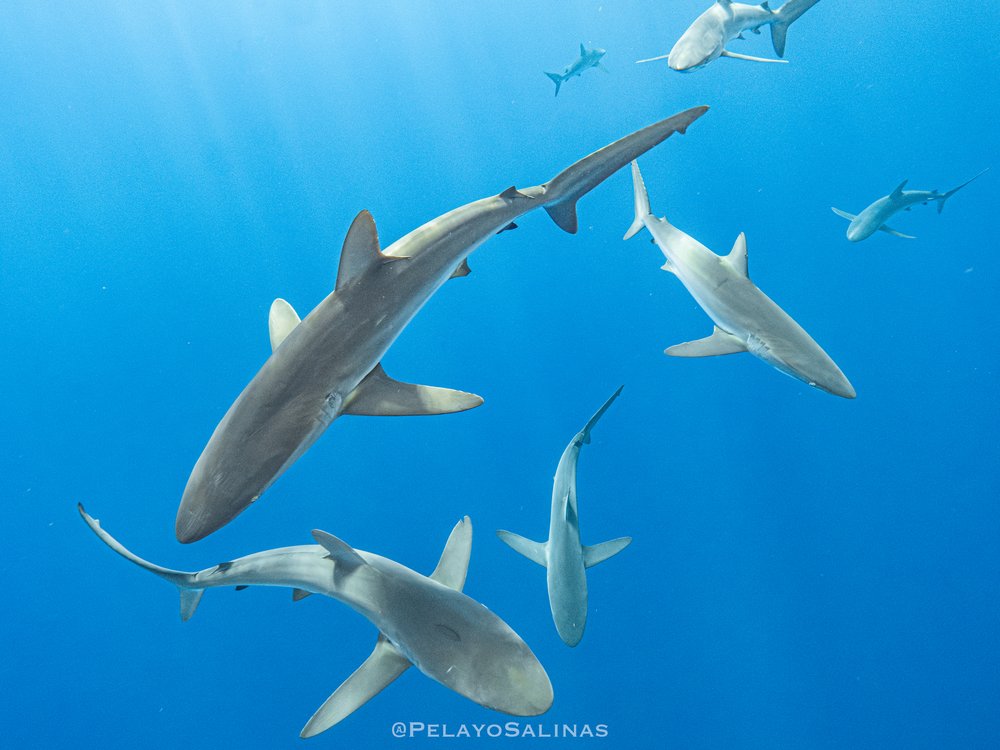
Pelayo Salinas de León/CDF
Dr. Shivji said: “The good news is that the silky sharks spent a substantial amount of time within the GMR, largely safeguarded from industrial fishing during this period. Concerning, however, is the discovery that the sharks, when deciding to migrate, preferentially travelled to the west and northwest rather than east of the GMR, ending up spending a lot of time in unprotected waters where a huge amount of industrial purse-seine and longline fishing occurs. These preferentially directional migrations point strongly to the wisdom of expanding MPAs to the west and northwest of the Galapagos, in addition to implementing other measures, to improve protection of this overfished species.”
Between 2010 and 2023, 53 MPAs were created in the Central and South American Pacific region, covering over 2.5 million km2 and making up 90% of the region’s MPA network. Furthermore, at the 2021 UN Climate Change Conference of the Parties (COP26), the governments of Panama, Ecuador, Colombia, and Costa Rica agreed to jointly create additional large MPAs.
The ETP supports many economically valuable ecosystem services, especially commercial fisheries, chief among them, tuna fisheries using purse seines and longlines. Both fishing methods have high levels of bycatch including marine mammals, sea birds, sea turtles, and sharks, many of which have experienced major population declines and are threatened with extinction. Silky sharks are particularly vulnerable to tuna-focussed purse-seine fisheries that use fish aggregating devices, which are large floating objects that attract fish in the open ocean.
“Our research also highlights that Marine Protected Area networks by themselves are not going to be enough to revert ongoing silky shark population declines. MPAs need to be complimented by fisheries policies aimed at ensuring that industrial fishing fleets operating around MPAs, including within biological corridors, are sustainably managed. One third of pelagic sharks and rays are now threatened with extinction, it is time to implement recovery plans to improve their conservation status,’ commented Dr. Pelayo Salinas de León, Senior Marine Scientist of the Charles Darwin Foundation for the Galapagos Islands and co-author of the study.
—ENDS—
To learn more about our Shark Ecology and Conservation, visit our program page:
For media enquires please contact:
Charles Darwin Foundation
Ambre Tanty-Lamothe, Daniela Ibarra
comunicacion@fcdarwin.org.ec
About the Charles Darwin Foundation
The Charles Darwin Foundation for the Galápagos Islands (CDF) is an international non-profit organization that has operated in Galapagos since 1959 under a special agreement with the Government of Ecuador. Its mission, and that of its Research Station, is to address the greatest threats and challenges facing Galapagos through scientific research and conservation actions, to protect one of the world’s most important natural treasures. Today CDF supports more than 25 research, conservation, and education projects across land and sea, and is the custodian of over 137,000 specimens in its Natural History Collections. Its diverse team of more than 140 scientists, educators, and support staff is composed primarily of Ecuadorian citizens, with over 60% from Galápagos.
For more information, please visit: www.darwinfoundation.org