The Archives That Connected Galápagos with World Science
How did a handful of isolated islands in the Pacific come to hold a central place in world science? The answer lies not only in laboratories and scientific publications. It also rests in the letters, maps, field notebooks and photographs kept by the Historical Archive of the Charles Darwin Foundation (CDF).
An institution built on many kinds of knowledge
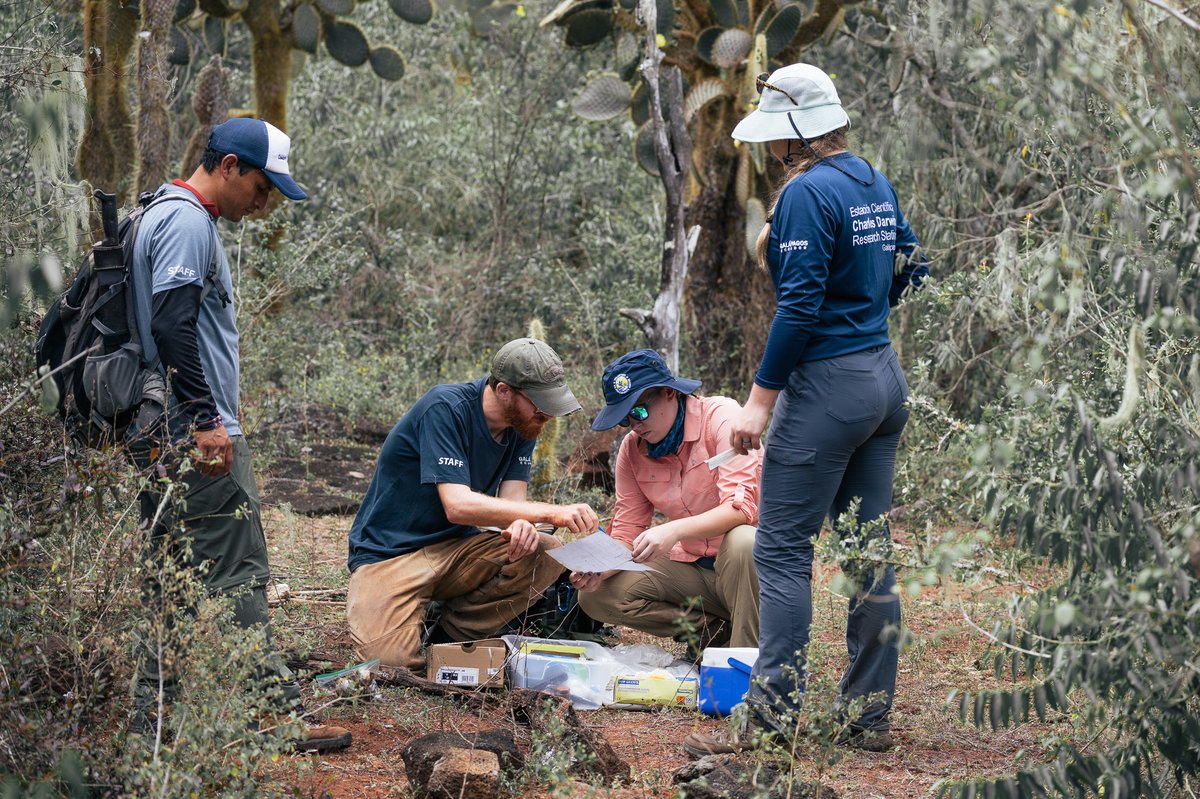
From its founding, the CDF brought together scientific, technical, practical and political knowledge. Biologists, zoologists, botanists, ornithologists, paleontologists and ecologists worked alongside diplomats, managers of scientific institutions, conservationists, artists and science communicators. When the Charles Darwin Research Station opened in 1964, educators, fellows, wildlife keepers, accountants, secretaries, mechanics, carpenters and masons joined them. That diversity confirms that scientific knowledge does not come from academia alone but from a complex interweaving of many kinds of knowledge.
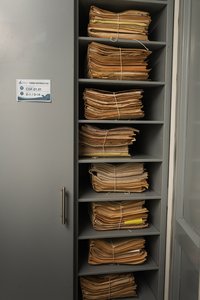
Today that fabric includes the Historical Sciences, led by the CDF Library, Archive and Museum Collection. Drawing on archival science, library science, cultural and environmental history, the history of science, paleography, iconography and museology, this team manages and brings to light the institutional and social memory of Galápagos.
Mara Speece CDF
Mara Speece CDF
Mara Speece CDF
Galápagos in the global network of science
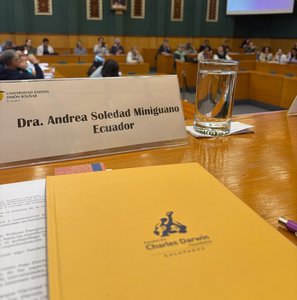
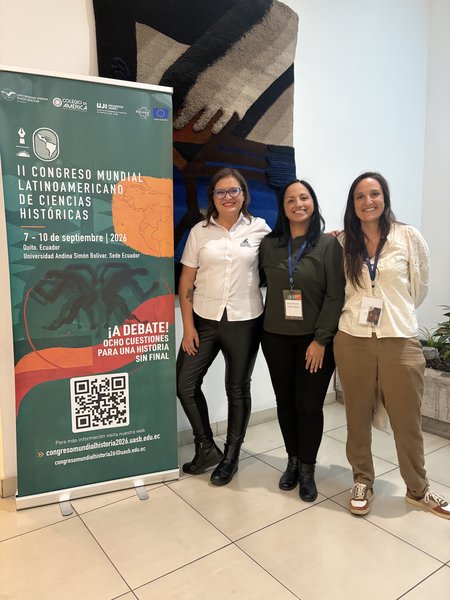
With that perspective, Dr. María José Barragán and I presented the paper “Archives of Science in Galápagos: Between the Local and the Global in the Construction of Scientific Knowledge” at the 2nd Latin American World Congress of Historical Sciences (CMLCH), as part of the panel “Time and Space: Between the Local and the Global.”
The study, based on a preliminary analysis of the CDF Historical Archive, shows how the islands, despite their geographic isolation, became part of international networks for producing, circulating and institutionalizing scientific knowledge from the mid-twentieth century onward. Two questions guided the work. How can we interpret, historically, the process through which Galápagos became a place of science with global reach? And how can we reconstruct today the networks of actors, institutions, territories and objects that made it possible?
Seen this way, the creation of Galápagos National Park and the Charles Darwin Foundation in 1959 is not an isolated event. It is the result of a network that involved scientists, diplomats, international organizations, Ecuadorian institutions and local actors, as well as nonhuman actants such as species, islands, vessels, instruments, laboratories and documents.
Andrea Miniguano CDF
The archive as a material trace
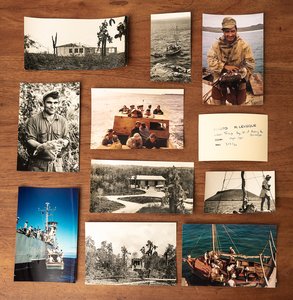
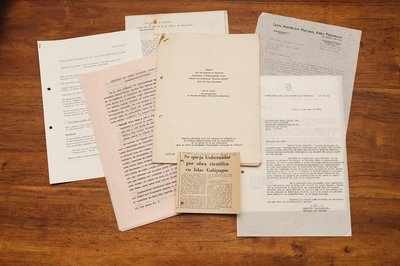
The research took a historical and documentary approach and used Bruno Latour’s actor-network theory as its interpretive framework. Letters, maps, photographs, field notebooks, reports, slides and agreements were analyzed as material traces of the connections between the local and the global.
We worked with the collections of Cristóbal Bonifaz, Daniel Weber, Tom Simkin and Craig MacFarland, as well as the Historical Administrative Collection, to identify networks linked to conservation, botany, volcanology, international cooperation, environmental governance and public policy. In this way, the archive ceased to be a mere repository and revealed itself as the material memory of a scientific network with the CDF at its center.
What the congress left us
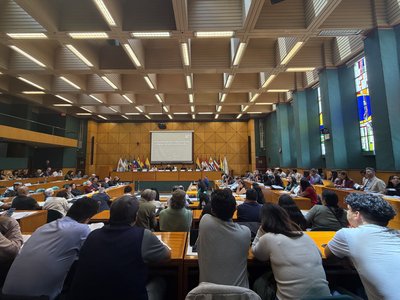
The meeting also offered valuable insights for the Archive’s work. Prati’s idea that “traveling is producing knowledge” invites us to read scientific expeditions as processes of observation and exchange, a key to the history of Galápagos. Ricardo Padrón, for his part, showed how maps turn individual experiences into broader spatial representations, a lead for studying the historical cartography of the archipelago.
Andrea Miniguano CDF
At the roundtable “Memory, Archive and Urban Dynamics,” Virginia Gamez highlighted the teaching potential of archives, while other speakers focused on history from below and on creative uses of documentary heritage in Ecuadorian documentary film, all references for future education and outreach projects. A study on Esperanza Base in Antarctica opens the door to a comparative dialogue on territorial occupation, community building and the role of science. Jazmín Duque included Galápagos in her study of women in the natural sciences of the northern Andes in the nineteenth and twentieth centuries. And on our own panel, Claudia Rosas revisited concepts such as Jacques Revel’s play of scales, the glocal, connected histories and the distinction between global history and globalization.
These tools will guide how the CDF identifies, organizes, interprets and showcases its collections.
A memory for the future
If Galápagos wove international networks to produce knowledge in the twentieth century, in the twenty-first century the Historical Archive can strengthen them or create new ones. Organizing, researching, digitizing and opening these collections means allowing new researchers and society at large to reinterpret those connections.
That is why it matters to keep enriching the Archive with the memory of those who have contributed over six decades, and to ensure that new research builds on the valuable information we safeguard. We remain committed to interdisciplinary work, which enriches us, compels us to engage in dialogue and lets us learn from one another so that each of us can contribute our best to the conservation of Galápagos.
Andrea Miniguano CDF