
Cine al Mar: Young Voices Telling Stories of the Sea
What stories of the sea lie behind the people we see every day in Galápagos? To find out, young people from the community became interviewers, camera operators, sound technicians and filmmakers. Through visual anthropology and community filmmaking, they reached out to other generations to listen to their stories and learn what the sea means in their lives.
Learning to Look
The process began with short visual anthropology workshops led by Romina Cahuana. Using embroidery, participants stitched images of their territory and identified community figures they had watched with curiosity for years. That is where the first questions arose.
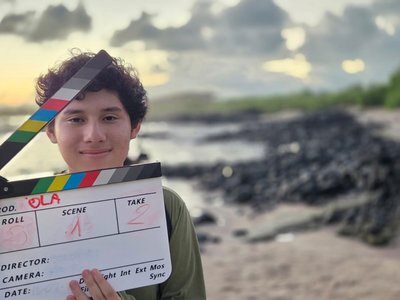
Adrián Aguilar then led community filmmaking workshops, where the young participants discovered that anyone can tell a story with basic tools. Through games, scene re-enactments and interviews, they learned ethnography and audiovisual production techniques.
Fernanda Loayza CDF
Bazán and the Waves
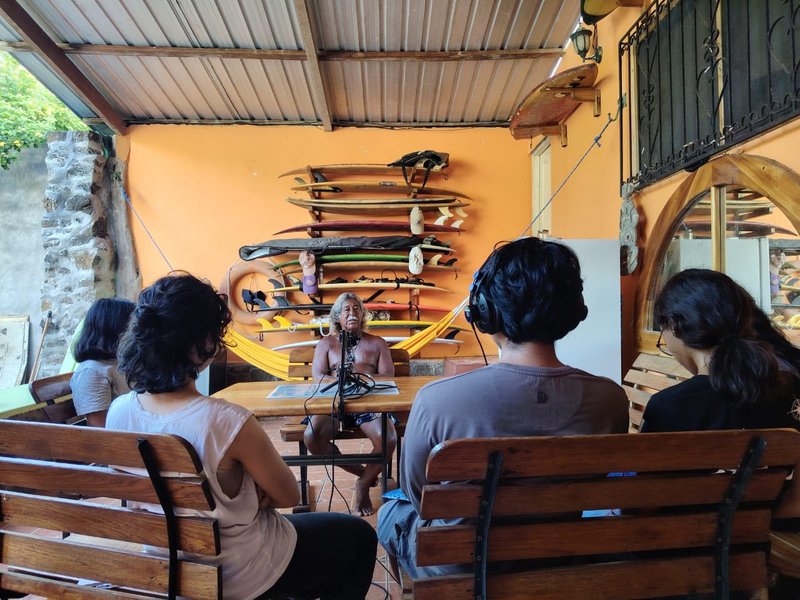
For this documentary, we arrived at Sergio Bazán’s house full of curiosity; he is known as a local surfing star. He is often seen walking barefoot while guiding groups, or riding through the streets of Puerto Ayora on his distinctive bicycle. Tuna, Luna and Negro, his dogs, greeted us, jumping happily and wagging their tails. Music playing in the background led us to the spot where the interview would take place, a space perfectly set by several surfboards lined up on the wall.
Bazán, as everyone knows him, kindly answered every question the young people asked. Little by little, through a conversation between two very different generations, they uncovered his story. Sarahí asked me to take her picture while she interviewed him so she could show it to her dad. Afterwards, Bazán showed us around his house, which we explored like a museum, among photographs from different stages of his life.
The encounter continued a few days later at Tortuga Bay. Bazán walked the trail barefoot, board under his arm, as he told us about his past and how he has seen the island change. As a young man, he made that same trip twice a day; today he is 72. When we arrived, he set up his small shelter, where he waits for the right moment to surf. He spoke to us about the wind and the waves, and let his gaze drift toward the horizon. For the young people, Bazán was no longer just the figure they had seen so many times around town: now they knew part of his story and his deep bond with the sea.
The Little Mermaids
For the documentary Las sirenitas (The Little Mermaids), the first encounter took place in an improvised podcast studio set up in a café. Anita and Emperatriz—whom we ended up calling Emperita—answered with patience and warmth, while the young people, notebooks in hand, put into practice what they had learned in the workshops.
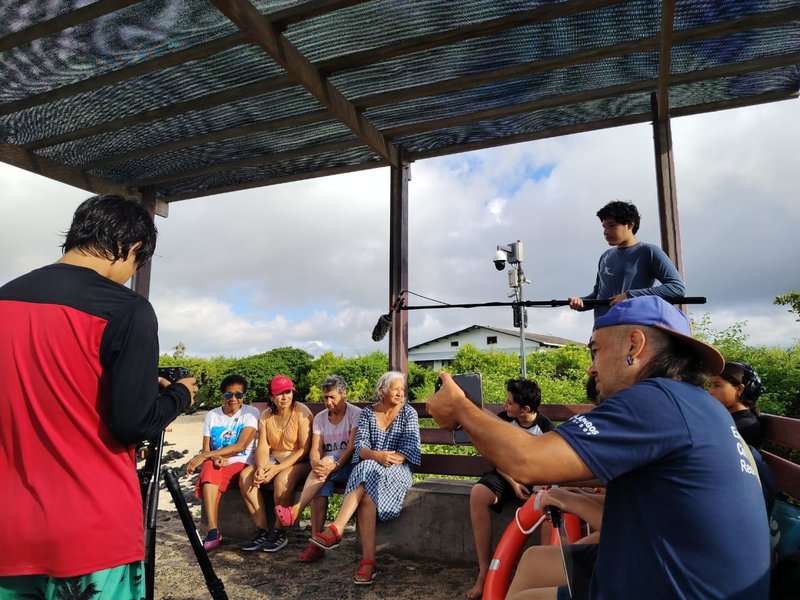
Fernanda Loayza CDF
Then came the sea. Before six in the morning, camera and microphone in hand, we joined Emperita, Germania, Anita and Charito at Playa de la Estación. The young people followed them into the water. Mathias swam alongside 85-year-old Emperita, trying to keep up with her pace: she lives up to her nickname, Sirenita, “the little mermaid.”
The camera stopped being just a tool and became a bridge to observe, ask, listen and share. “The most important thing I learned was to see the community and the sea through different eyes, to see that we are all connected to the sea,” said one of the participants.
Their Own Story
Then a new question emerged within the group: what story did each of them want to tell? Through games and brainstorming, the characters of a fictional film were born: Las sombras del náufrago (The Castaway’s Shadows). The camera no longer made them nervous; they felt confident enough to propose ideas, make mistakes and try again.
On the day of the shoot, ideas turned into scenes. There was makeup, acting, camera work, sound and assistance, but also fatigue, laughter, camaraderie and plenty of teamwork. Every contribution found its place until it all became a collectively built story.
At the preview screening, their pride was evident. They talked about what they had learned, their challenges and anecdotes, but also about something harder to measure: what it means to feel capable of expressing their own perspective, representing the perspectives of others and seeing themselves reflected in them. “It made me see the sea differently, look for another angle, see it through someone else’s eyes,” said another voice in the group.
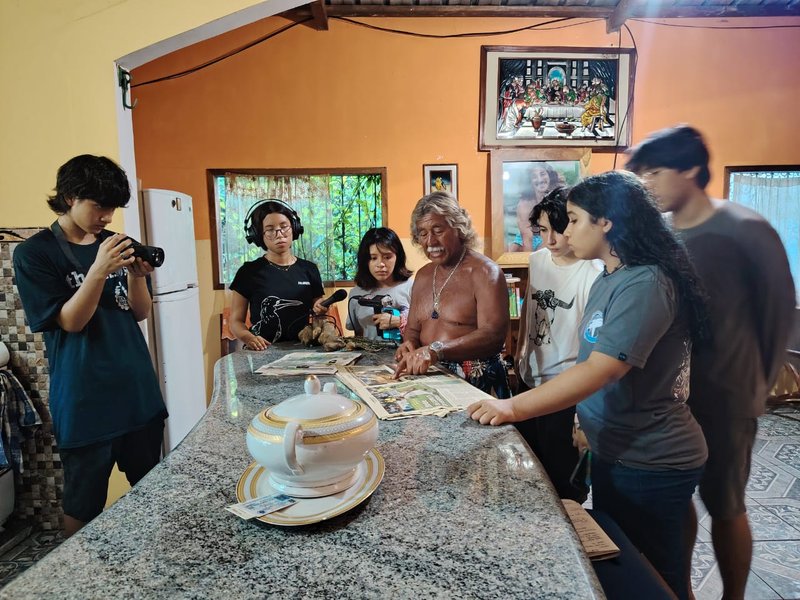
Fernanda Loayza CDF
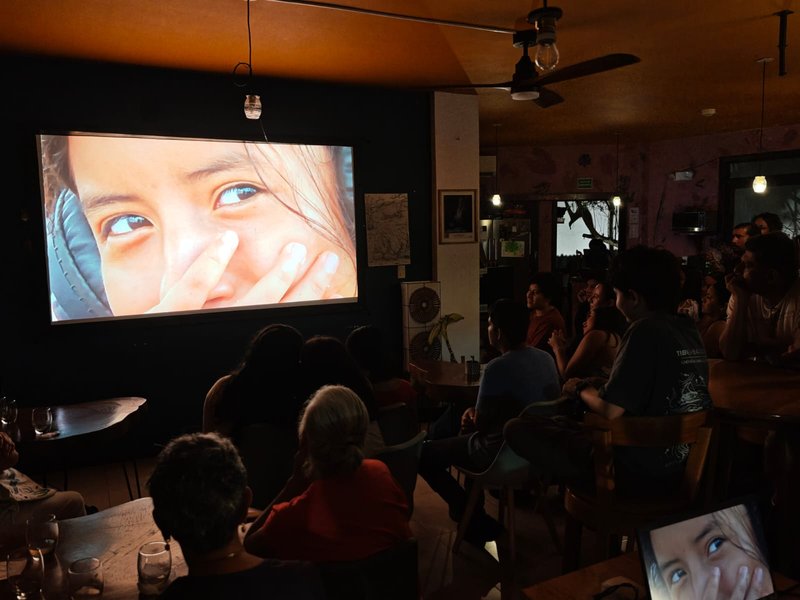
David Guijarro CDF
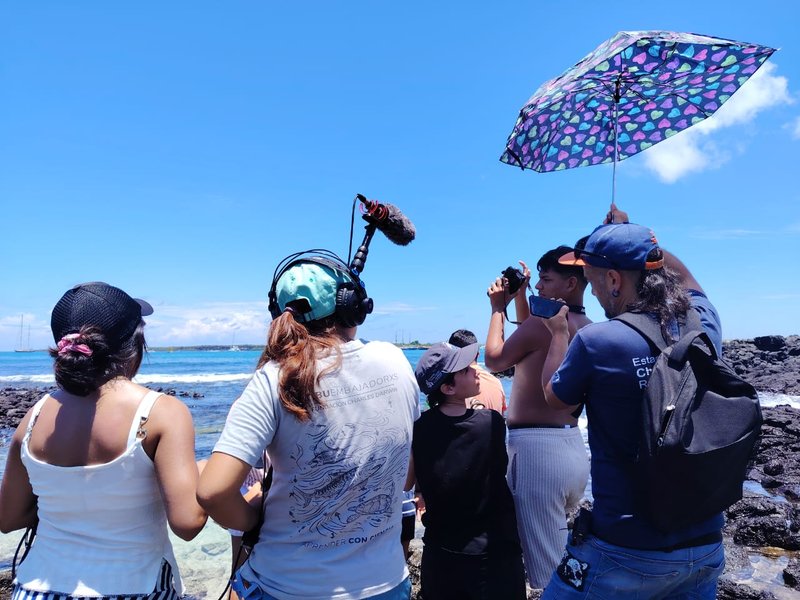
Fernanda Loayza CDF
Cine al Mar reminds us that young people have a lot to say, and that when there are spaces to listen, create and come together, they also discover new ways of connecting with their community and their territory.
This experience was made possible with support from the Galápagos Life Fund.