The Gerard M. Wellington Collections
Half a Century of Recording Galapagos Marine Biodiversity
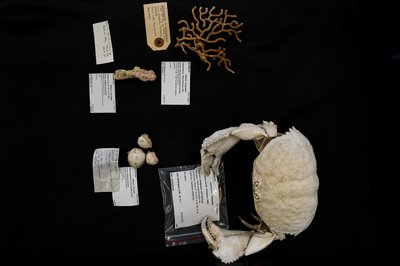
Between 1973 and 1999, marine ecologist Gerard M. Wellington collected approximately 773 specimens across nearly the entire archipelago. Today, these specimens, preserved at the Charles Darwin Research Station, make it possible to compare the Galapagos sea of the 1970s with that of today.
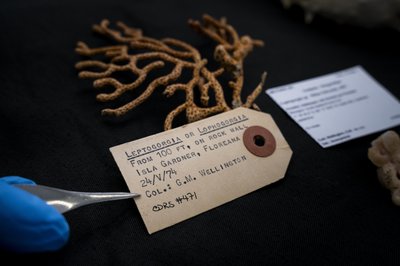
One of them is a coral collected on January 1, 1975, at Tagus Cove, on Isabela Island. It is currently held in the Marine Organisms Collection of the Charles Darwin Research Station under catalog number MCCDRS 142.
It was collected by Gerard M. Wellington, "Jerry" to his colleagues. That coral would become one of the first known specimens of a species that would bear his name. It is one of the 773 organisms the scientist left in the Station's Natural History Collections.
Fifty years later, these specimens continue to reveal which species lived in the islands, and where.
773 records, nine major groups
The database attributes 577 records in the Marine Collection (MCCDRS) and 196 in the Herbarium (CDS) to Wellington, most of them algae.
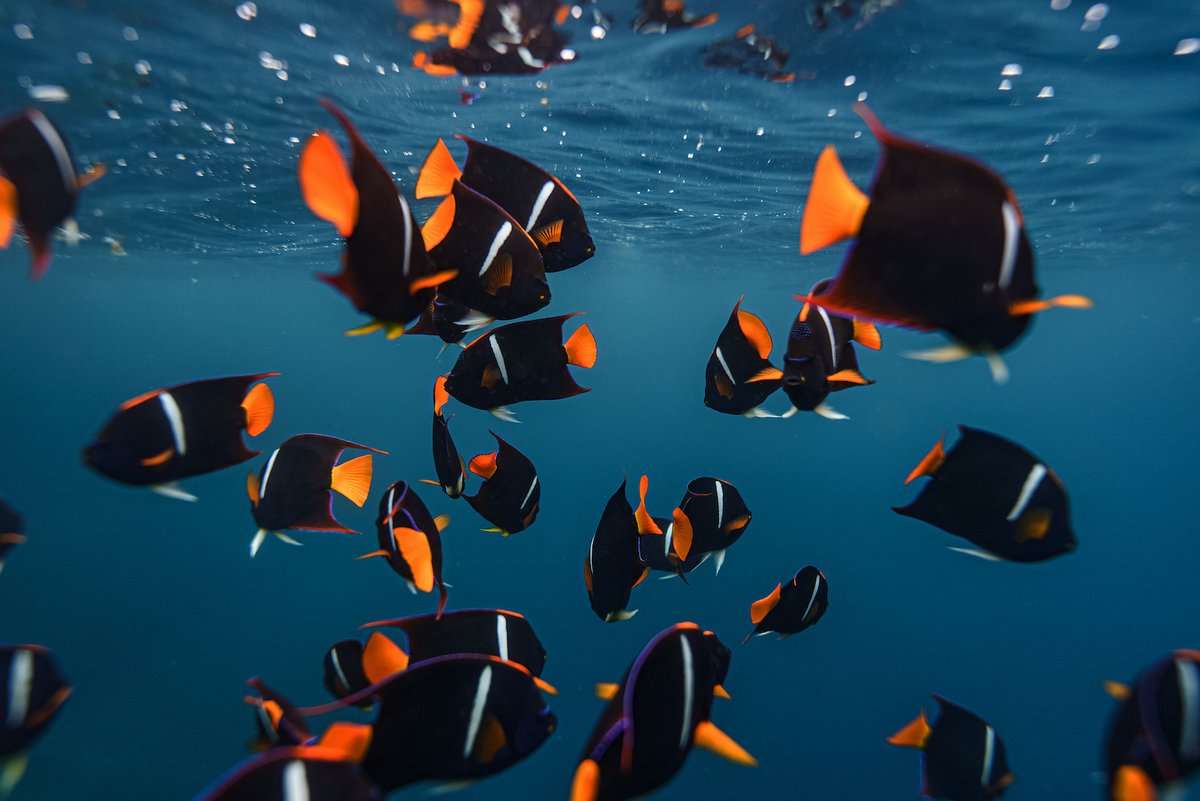
Although the scientific community remembers him for his studies on corals and fish, Wellington collected organisms from nine major groups. Arthropods, mainly crustaceans, top the list with 200 records. They are followed by cnidarians, such as corals and anemones, with 143, and red algae, with 136. The rest of the set comprises mollusks (101), chordates, mostly fish (68), echinoderms, such as sea stars and sea urchins (62), brown algae (46), green algae (14) and bryozoans (3).
Three years of intense fieldwork
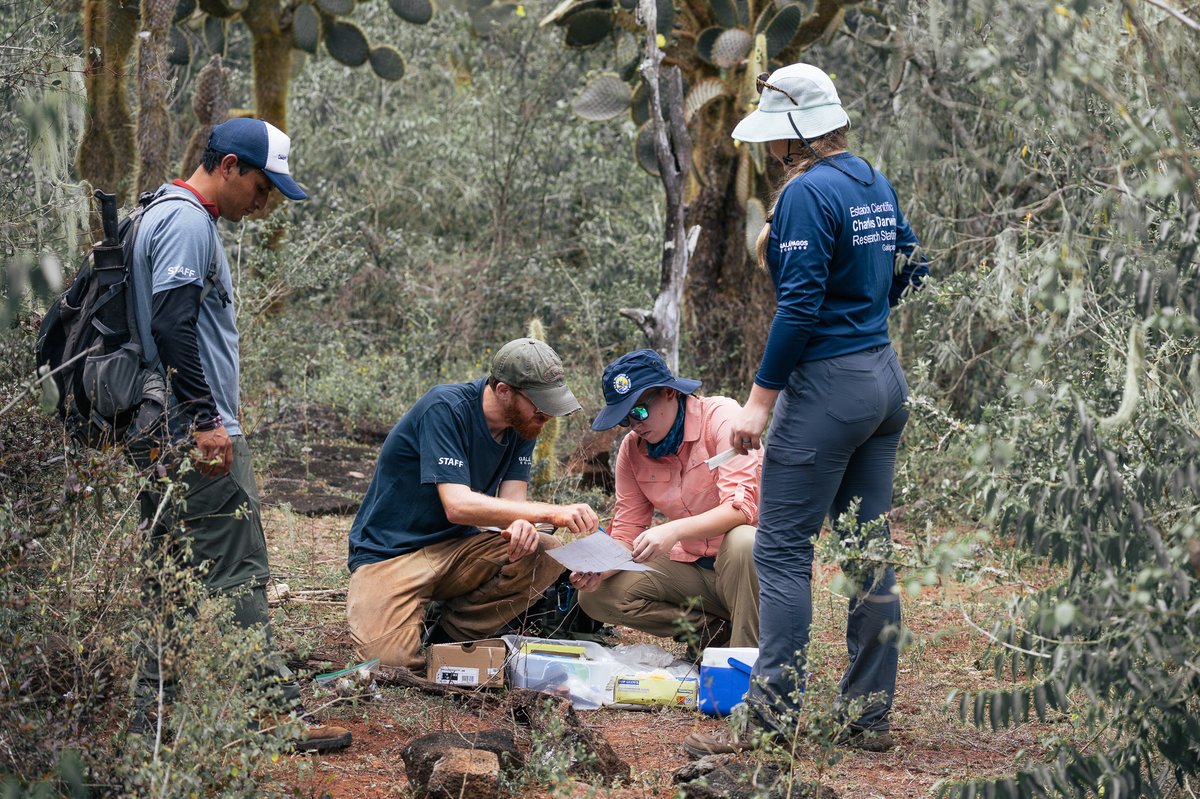
Wellington's records span from 1973 to 1999, but most of his collecting was concentrated in a short period. A total of 727 of the 773 specimens date from 1973–1975 alone, when he served as a U.S. Peace Corps volunteer assigned to the Charles Darwin Research Station and the Ecuadorian National Parks Service.
Carlos Espinosa CDF
Santa Cruz, Fernandina and Isabela account for the largest number of collections, followed by Santiago and Floreana. He also collected on Española, Genovesa, Darwin, Wolf and other islands.
Inti Keith FCD
A specimen that became a species
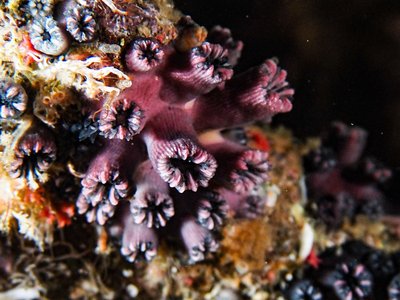
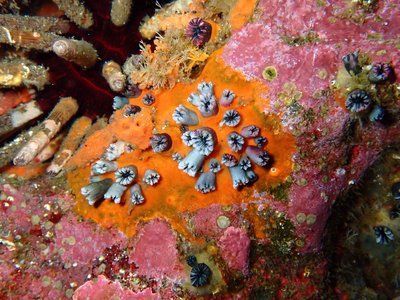
Wellington's name is also linked to the description and classification of species. Three species bear his name, two of them endemic to Galapagos. One is Wellington's solitary coral, Rhizopsammia wellingtoni Wells, 1982. Wellington collected some of the first known specimens of this species, including MCCDRS 142 from Tagus Cove. The second is the scorpionfish Scorpaena wellingtoni Victor, 2013, also endemic to Galapagos.
The story of the solitary coral shows the value of these collections. After 24 years without records, it was listed as "Critically Endangered, Possibly Extinct." However, in January 2024, researchers from the Charles Darwin Foundation, the California Academy of Sciences and the Galapagos National Park Directorate found more than 250 living colonies on Isabela and Fernandina. More than 100 of them were south of Tagus Cove, where Wellington collected his specimen in 1975.
Academic career
Wellington graduated in Biology from San José State University, California, in 1971, and traveled to Galapagos shortly afterward. In 1976 and 1977, he published two proposals in Noticias de Galápagos for the creation and management of a marine park. These were forerunners of the Galapagos Marine Reserve, established in 1998.
In 1981, he earned his PhD in Biology from the University of California, Santa Barbara. From 1982, he taught ecology, marine biology and invertebrate zoology at the University of Houston, and was a research associate at Rice University.
In 1983, he and Peter W. Glynn published Corals and Coral Reefs of the Galápagos Islands, a reference work for the study of the archipelago's corals. His research also documented the mass mortality associated with the 1982–1983 El Niño event.
In 1993, he and Daniel Gleason showed in the journal Nature that ultraviolet radiation causes coral bleaching. He also used coral skeletons to reconstruct centuries of climate variability in the Pacific. He served on the editorial board of the journal Coral Reefs and advised the Charles Darwin Foundation, which awarded him the Charles Darwin Medal for Conservation in 2000.
Carlos Espinosa CDF
Billy Bensted Smith CDF
A baseline for measuring change
Wellington died on March 11, 2014. Three years later, in 2017, the Charles Darwin Foundation created the Dr. Gerard "Jerry" Wellington Marine Climate Change Project in his honor.
His legacy also lives on in the hundreds of specimens he collected in Galapagos. Today, they are a historical reference for the archipelago's marine and coastal biodiversity, especially from the 1970s. By comparing them with current studies, researchers can learn how species and their distribution have changed over time.
In an archipelago exposed to ocean warming and increasingly intense El Niño events, information from half a century ago helps researchers understand these changes and provides valuable input for conservation.