
Galapagos remains the world's greatest living laboratory
for understanding evolution
Juan Manuel Carrión
For more than four decades, Juan Manuel Carrión has dedicated his life to observing, illustrating, and understanding Ecuador's natural world. A biologist, ornithologist, scientific illustrator, and environmentalist, he has become one of Ecuador's leading communicators of bird conservation and one of the country's strongest voices for biodiversity protection.
A co-founder of organizations such as Aves y Conservación and Ecociencia, Carrión has also maintained a close connection with the Galápagos Islands, where he serves as a governing member of the General Assembly of the Charles Darwin Foundation. In this interview, he reflects on the uniqueness of Galápagos birds, the importance of scientific research, and the role the Charles Darwin Foundation has played in educating generations of Ecuadorian scientists.

Mara Speece CDF
Mara Speece CDF

Mara Speece CDF
How did your connection with Galápagos begin?
Galápagos was always part of our education as biology students at the Pontifical Catholic University of Ecuador. Our professors constantly spoke about the islands and inspired us to see working there as a professional goal. We also studied alongside classmates from Galápagos who shared their experiences and strengthened our interest.
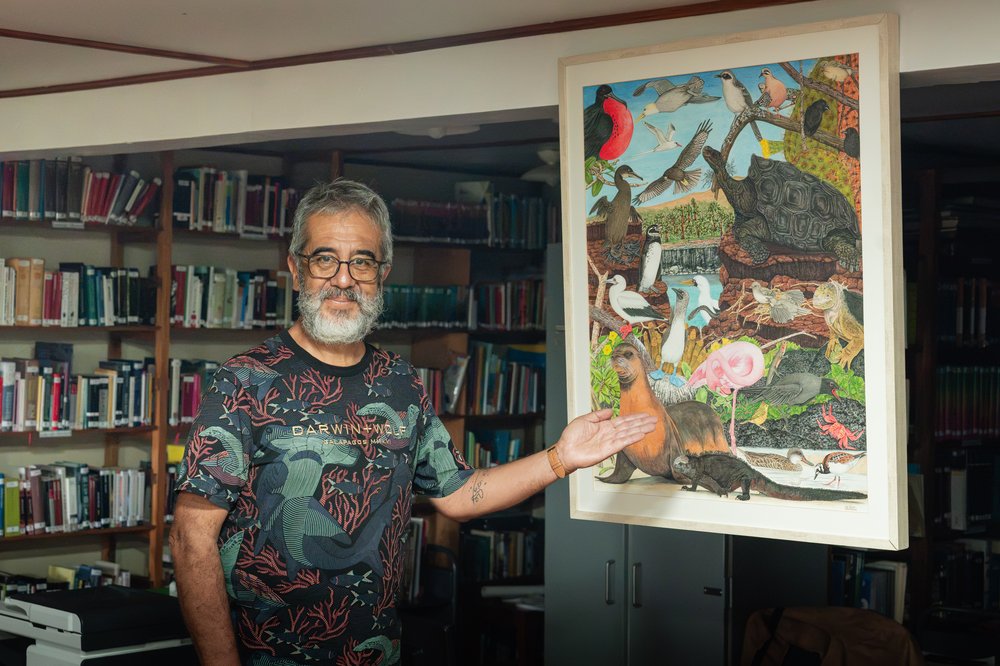
I first visited Galápagos in the early 1990s while working on a scientific illustration project. Since then, I have maintained a close connection with the islands. My daughter Carolina worked for six years at the Charles Darwin Foundation, while my son Santiago spent the pandemic in Galápagos and later taught for two years at Tomás de Berlanga School. One of my illustrations of Galápagos birds is displayed in the Foundation's library, and its poster version is available at the Charles Darwin Research Station Visitor Center.
Galápagos birds are famous around the world. What makes them so unique?
What makes them extraordinary is that they represent one of the world's greatest examples of evolution in action. A large proportion of the birds are endemic, meaning they exist nowhere else because they evolved independently on these islands over millions of years.
Darwin's finches are the best-known example. A common ancestor reached the archipelago and gradually gave rise to different species, each adapted to a specific ecological niche. The woodpecker finch, for example, uses cactus spines as tools to extract insects from tree trunks, replacing the role that woodpeckers play on the mainland.
Galápagos is also home to remarkable species such as the vampire finch, which feeds on the blood of boobies during periods of food scarcity; the flightless cormorant, the only flightless cormorant in the world; and the Galápagos penguin, the only penguin species that lives so close to the Equator.
What did Peter and Rosemary Grant's research contribute?
Their work transformed our understanding of evolution. For decades, they studied Darwin's finches on Daphne Major Island and showed that natural selection can be observed in real time.
They demonstrated that events such as El Niño and droughts change food availability, and that even small differences in beak size can determine which birds survive. Their research provided compelling evidence that evolution is not only a process of the past—it is happening continuously today.
Why is Galápagos such an important destination for birdwatchers?
Because visitors can observe species that exist nowhere else on Earth. For birdwatchers, Galápagos is one of the world's premier destinations.
Birdwatching tourism also represents a major opportunity for Ecuador. These visitors are highly specialized, eager to learn, financially capable, and deeply committed to conservation. Countries such as Costa Rica have built much of their nature tourism industry around birdwatching. Ecuador has even greater bird diversity and enormous potential to further develop this sector.
Mara Speece CDF
How do you assess the work of the Charles Darwin Foundation?
The Charles Darwin Foundation deserves tremendous recognition. Together with the Galápagos National Park Directorate, it has generated the scientific knowledge needed to conserve this extraordinary natural heritage.
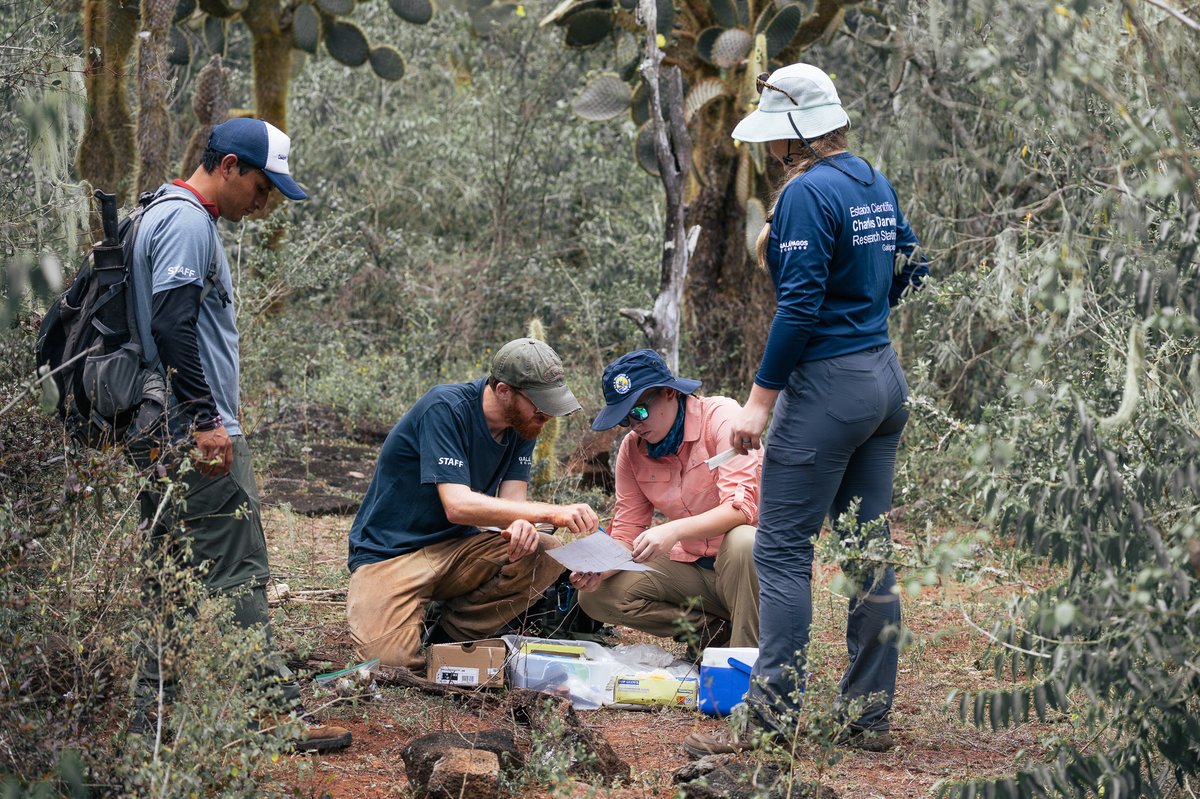
One contribution often goes unnoticed: developing local scientific talent. Today, Galápagos-born scientists lead research projects that, a few decades ago, were carried out almost exclusively by international researchers. Many of these scientists discovered their vocation through the Foundation's library, educational programs, and direct interaction with researchers. That may be one of the Foundation's greatest legacies.
The Foundation has also built a strong institutional model with an international outlook, allowing it to sustain long-term research and develop world-class scientific infrastructure.
What message does Galápagos send to the world?
Galápagos shows that science is essential for conserving nature. The islands remain a living laboratory where researchers can understand how evolution works, how species respond to environmental change, and how scientific knowledge can guide conservation decisions.

Mara Speece CDF
For Juan Manuel Carrión, protecting Galápagos depends on strengthening scientific research, training the next generation of scientists, and turning knowledge into action. He sees the Charles Darwin Foundation as a leading institution that advances science, develops local talent, and provides the knowledge needed to safeguard one of the world's most extraordinary natural treasures.