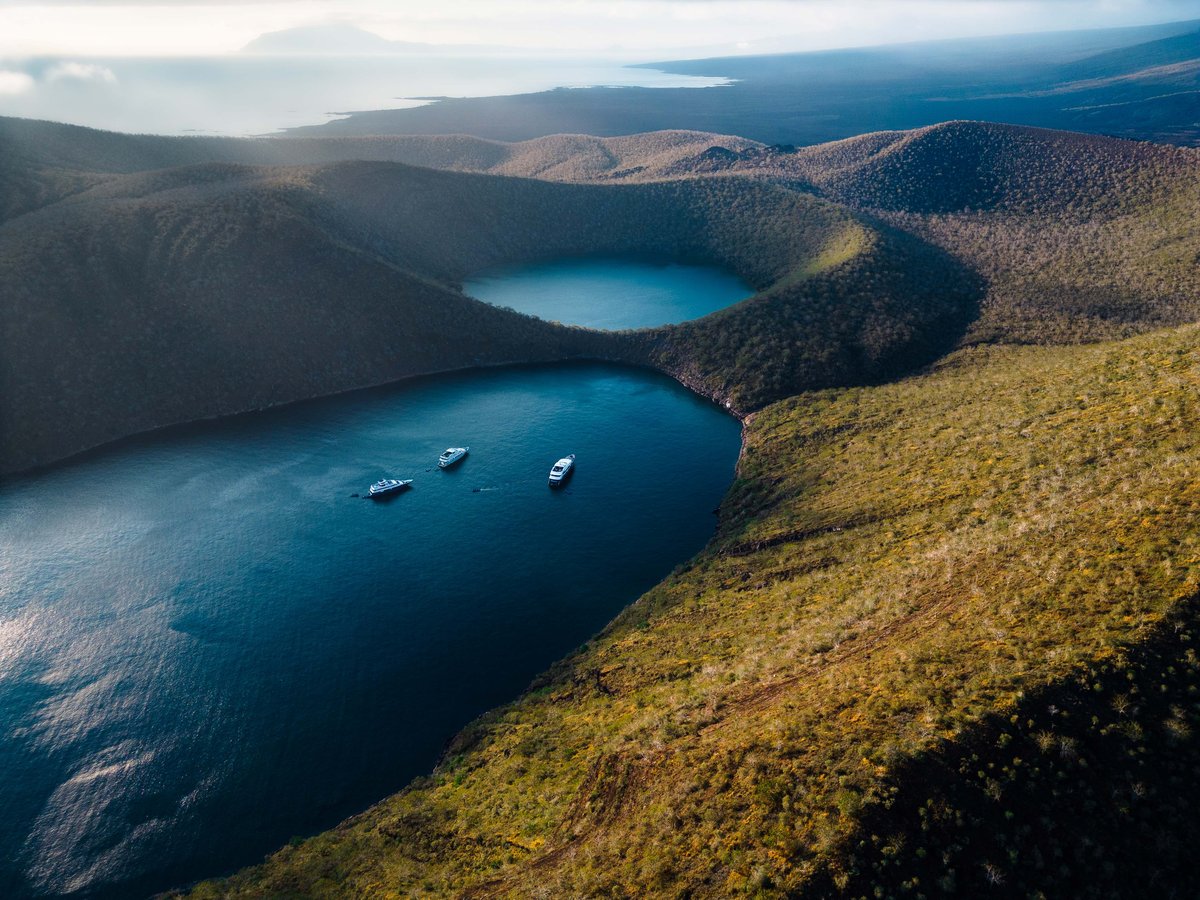
This newly-discovered blue octopus from the Galápagos Islands could curl up in the palm of your hand
Galápagos, May 26, 2026 - The Galápagos Islands off the coast of Ecuador are home to more than a thousand plant and animal species found nowhere else on Earth— things like marine iguanas and giant tortoises. In a new paper in the journal Zootaxa, scientists announced the discovery of the newest animal found in the Galápagos: a tiny blue octopus.
The octopus was first spotted during a 2015 deep-sea expedition conducted aboard the E/V Nautilus, in collaboration with the Charles Darwin Foundation (CDF) and the Galápagos National Park Directorate (GNPD). From the ship, the crew used a remotely operated underwater robot to explore the ocean floor near Darwin Island, an island at the northern edge of the Galapagos archipelago named after the biologist whose work there helped him formulate the theory of evolution.
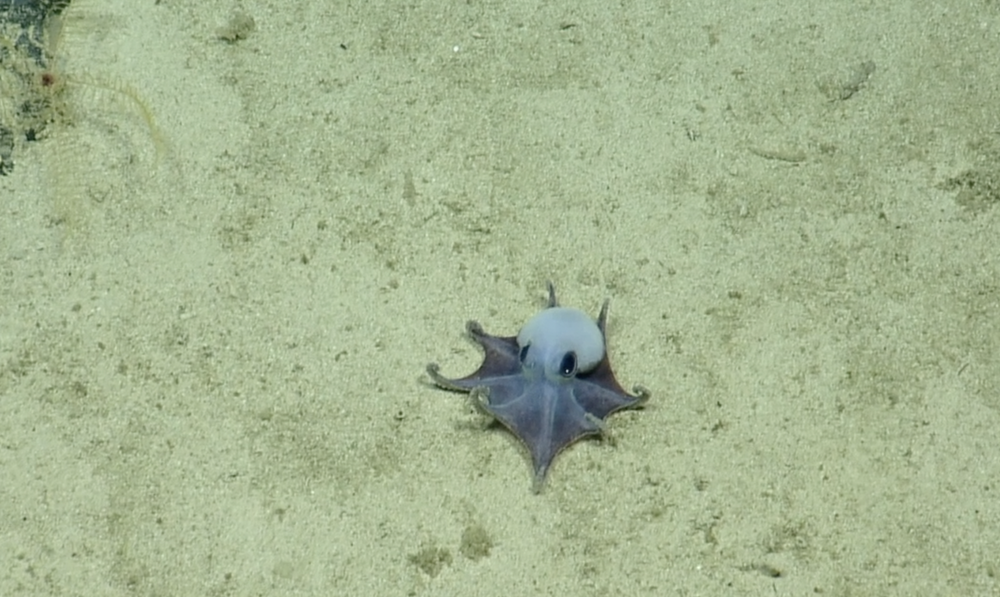
As the ROV’s camera moved over the sea floor near an underwater mountain, 5,800 feet (1,773 meters) below the water’s surface, the researchers noticed an octopus. The audio from the ROV footage includes the scientists’ first reactions to the animal:
“He’s tiny!”
“It’s blue!”
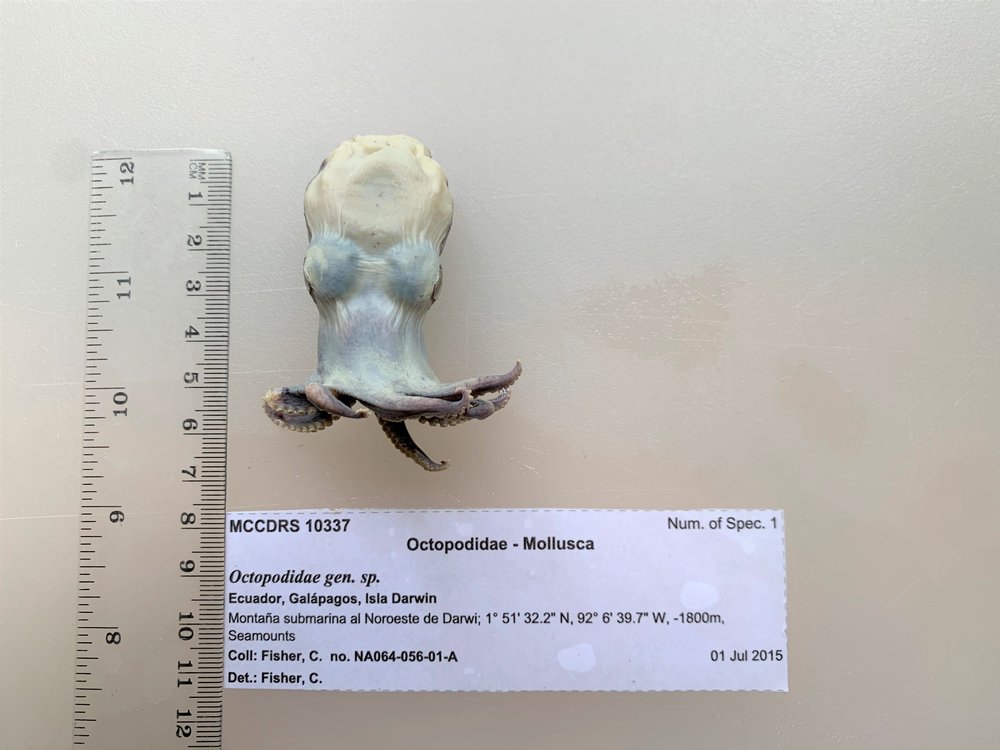
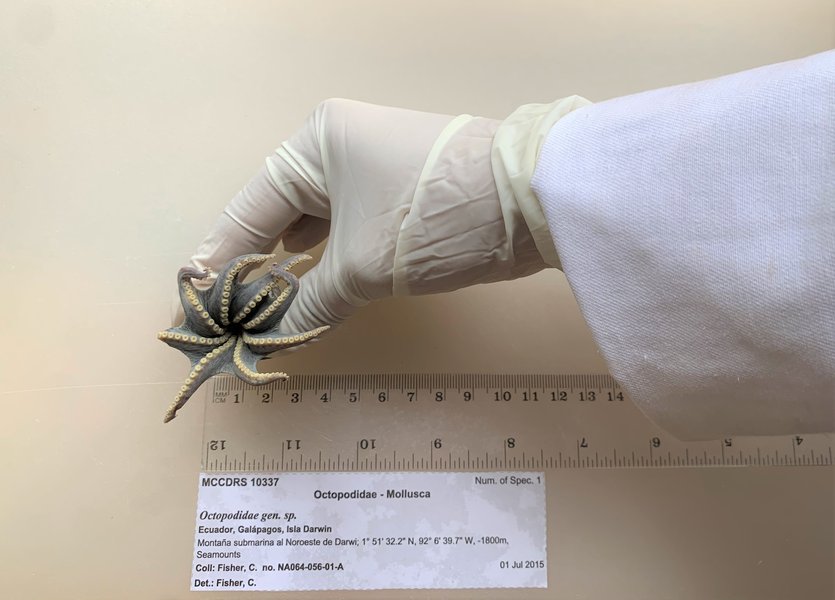
Using the ROV, the crew was able to collect the octopus; over the course of their mission, they captured video footage of two others that looked like it. When the scientists returned from the mission, they brought the dozens of deep sea specimens that they had collected to the Charles Darwin Research Station. There, CDF researchers sorted through the specimens, and the tiny blue octopus–about the size of a golf ball– stood out. Unsure what species it belonged to, they contacted octopus expert Janet Voight and sent her a photo of the animal.
CDF
“Right away, I knew it was something really special,” says Voight, curator emerita of invertebrates at the Field Museum in Chicago and the lead author of the study describing the new species. “I’d never seen anything like it.”
The research team at the Research Station in Galápagos preserved the octopus’s body in alcohol and formalin, and they sent the specimen from the Galápagos Islands to Chicago for Voight to examine at the Field Museum. The little octopus was indeed one-of-a-kind, which posed a challenge for scientific research.
“When you describe a new species of octopus, you have to look at all the parts, including the mouth, the beak, and the teeth. And to see those things, you have to cut the specimen open. We only had the one specimen, so I didn’t want to take it apart,” says Voight.
CDF
So, she worked with Stephanie Smith, the manager of the Field Museum’s X-ray computed tomography laboratory, to create CT scans of the octopus instead.
“Because CT imaging is non-destructive, it's especially important for type specimens like this one. And that's great for me because people are often bringing me these incredibly rare and stunningly beautiful specimens that I get the privilege of virtually opening up,” says Smith, a co-author of the paper describing the new species. “There’s nothing like spending the day looking at something no other human has ever seen.”
With CT imaging, thousands of X-rayed slices of an object are digitally compiled to create a 3D model of that object, inside and out. They can reveal what’s inside of an object without cutting it open. In the case of the little blue octopus, the researchers were able to see fine details of its internal organs, including its mouth, that helped provide the information needed to declare it a new species to science and suggest where it fits among other octopods.
“What really struck me was that the scan of the little octopus revealed so much information on its internal organ systems— usually, soft-part imaging using CT requires the use of heavy-metal-based contrast agents whose use would not be desirable with such a rare specimen. This made the 3D modeling of relevant organs really an easy task,” says Alexander Ziegler, a researcher at the University of Bonn in Germany and senior author of the paper.
The new species, Microeledone galapagensis, has another claim to fame beyond being a cute little blue octopus from the Galápagos: it’s the first new octopus species that Voight has officially led a team of scientists in describing, in her four-decade career studying octopus evolution.
“These are little octopuses that live in the deep sea, and hardly anybody on Earth has ever gotten to see them. I just feel lucky that I got to work with them,” says Voight. “If you took all the land on Earth and pieced it together, you would not cover the Pacific Ocean. The oceans are so big, and there’s so much left to explore.”
And this exploration of the oceans is critical to conservation efforts.
“When we were sorting through dozens of specimens collected during the expedition, this tiny blue octopus fascinated us,” said Dr. Salome Buglass, marine scientist at the University of California of Los Angeles, former researcher at the Charles Darwin Foundation and co-author of the paper. “There was something unusual about it, so we went out of our way to find the right person to help us identify what it was. Getting the specimen to Janet was a long process, but one I would gladly repeat if it means getting to know the most precious parts of our ocean just a little bit better. Discoveries like these remind us how much of the deep ocean in Galápagos remains unexplored. Every new species helps us better understand these hidden ecosystems and why protecting them matters.”
CDF
“Galápagos Marine Reserve still harbors ecosystems and species that remain unknown to us. Discoveries like this demonstrate the importance of coordinated efforts between science and conservation to expand our understanding of our oceans and strengthen the proper management of protected areas,” said Lorena Sánchez, Director of the Galápagos National Park. “Each new study provides valuable information to better understand marine biodiversity and reaffirms the importance of protecting these unique ecosystems for future generations.”
-END-
For media enquiries please contact:
Charles Darwin Foundation
Ambre Tanty-Lamothe or Daniela Ibarra |comunicacion@fcdarwin.org.ec
Field Museum
Field Museum Public Relations relationspress@fieldmuseum.org
About the Charles Darwin Foundation
The Charles Darwin Foundation for the Galápagos Islands (CDF) is an international non-profit organization that has operated in Galápagos since 1959 under a special agreement with the Government of Ecuador. Its mission, and that of its Research Station, is to address the greatest threats and challenges facing Galápagos through scientific research and conservation actions, to protect one of the world’s most important natural treasures. Today CDF supports more than 25 research, conservation, and education projects across land and sea, and is the custodian of over 137,000 specimens in its Natural History Collections. Its diverse team of more than 140 scientists, educators, and support staff is composed primarily of Ecuadorian citizens, with over 60 % from Galápagos. For more information, please visit: www.darwinfoundation.org