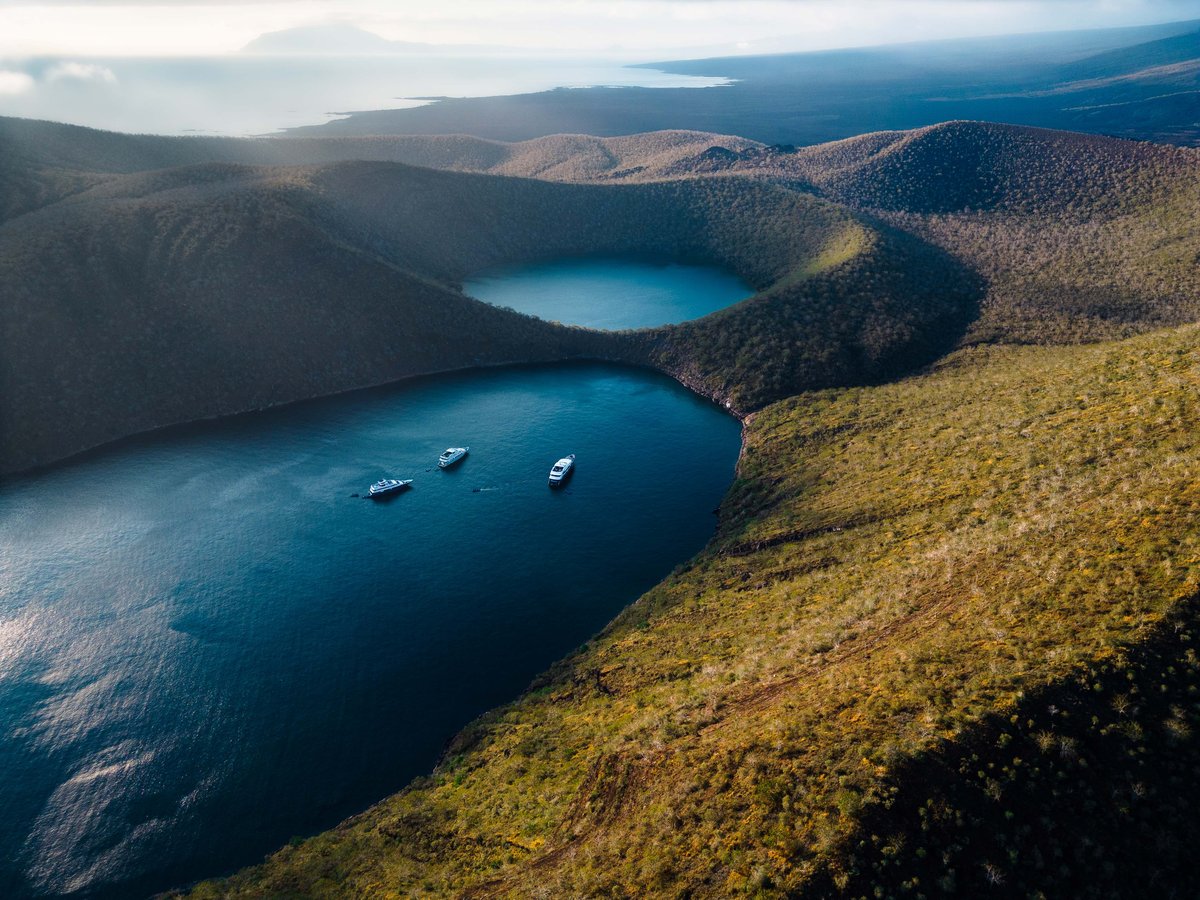

Field Notes from the Galápagos: My Time as a Collaborating Scientist at the Charles Darwin Foundation
In summer 2025, I had the privilege of working alongside the incredible team at the Charles Darwin Foundation (CDF) in Puerto Ayora, Galápagos. As a collaborating scientist hosted by Dr. Heinke Jäger, I had the chance to contribute to a diverse set of conservation and research projects. Each one deepened my appreciation for the people, species, and ecosystems that make these islands unique. This experience has been part of my professional development leave, or sabbatical. I set out to broaden my skills and experience as a scientists and extension agent. I can say with confidence that my time spent here, learning about Galapagos systems, meeting wonderful people, and supporting research and conservation, has made me a better professional. I am excited to apply the skills and perspectives I have gained here to my work at the University of Florida.
Tracking the Growth of an Invader
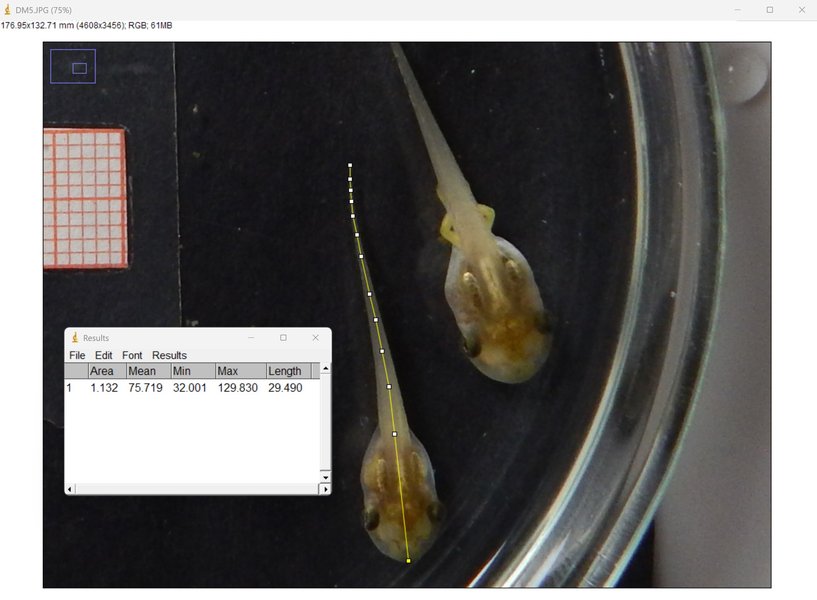
One of my first projects involved studying the invasive Fowler’s Snouted Treefrog (Scinax quinquefasciatus), a frog native to coastal mainland Ecuador that was accidentally introduced to the islands as a stowaway. Using ImageJ software, I measured tadpoles from an experiment investigating how density affects their growth and survival. The experiment is led by a master’s student studying at the Pontificia Universidad Católica in Quito. The findings will provide better understanding of the species’ biology to include in the development of potential management strategies in Galápagos. It was a reminder that even the smallest creatures can ripple through an ecosystem in big ways.
Watching a Forest Heal
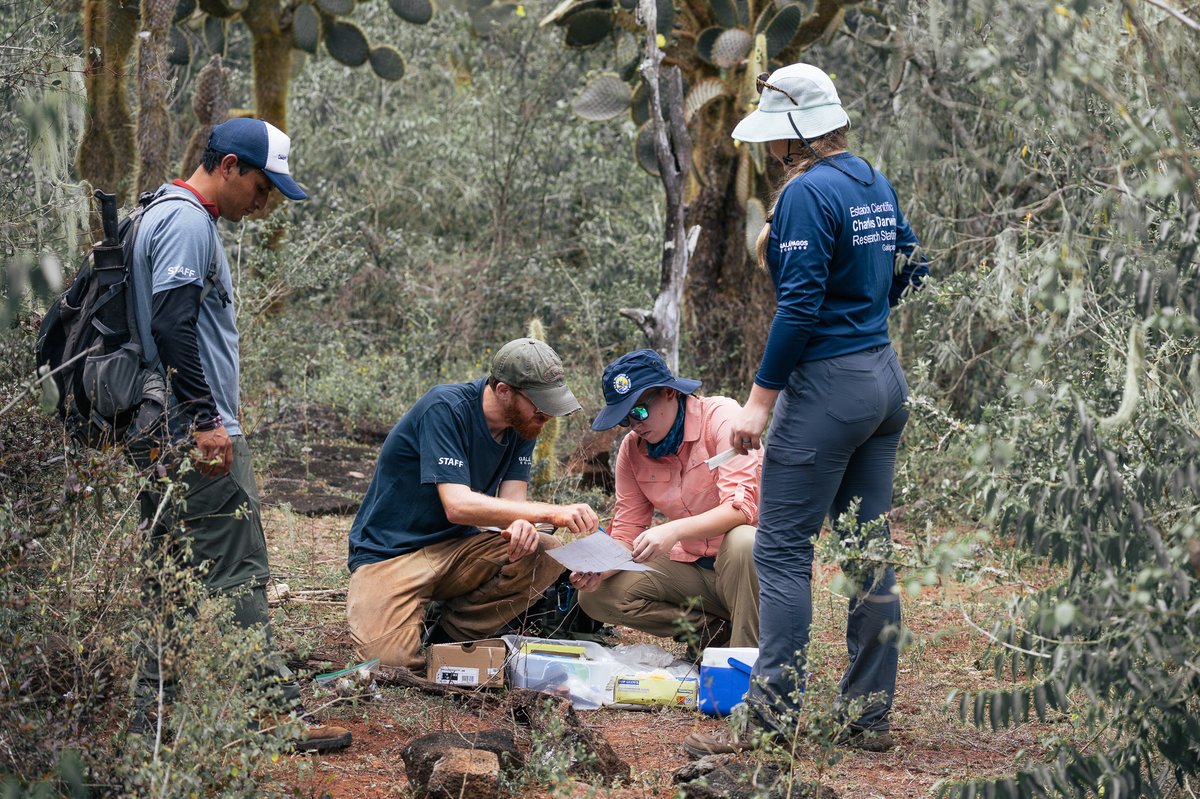
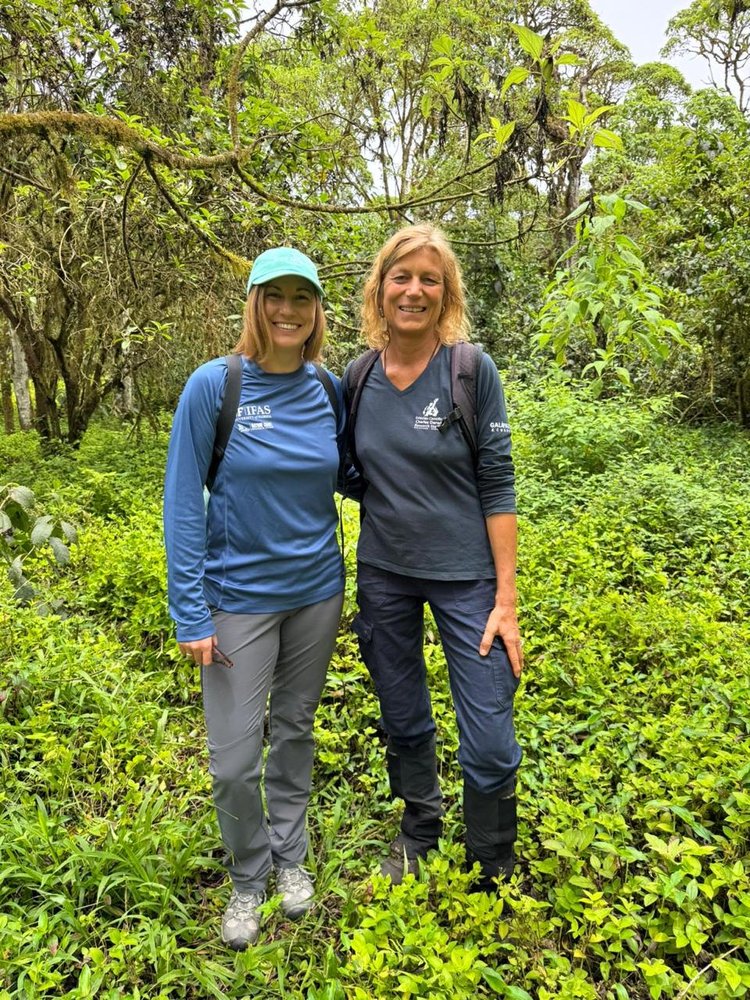
I also joined Dr. Jäger in the highlands of Isabela Island to monitor the regeneration of endangered Scalesia trees, found only in Galápagos. The Scalesia forests of Galápagos are threatened by multiple invasive species, especially blackberry, that choke out light and prevent germination and growth of young trees. Using the line intercept transect method, we measured plant cover along permanent lines that are revisited annually, recording everything from endemic species to stubborn invasives. We also collected measurements of the diameter-at-breast-height (DBH) and height of mature Scalesia trees. These long-term datasets guide decisions on invasive removal and replanting, ensuring that limited resources are used where they matter most. During this field excursion, we visited a restoration site where nursery-reared Scalesia cordata had recently been planted. This was a special experience because S. cordata is not only endemic to Isabela but also endangered and these new, collaborative efforts to restore them are providing new hope the species can be saved. Walking those transects with Dr. Jäger herself was a surreal privilege and it was inspirational to be surrounded by so many young S. cordata trees!
Diving into Marine Gradients
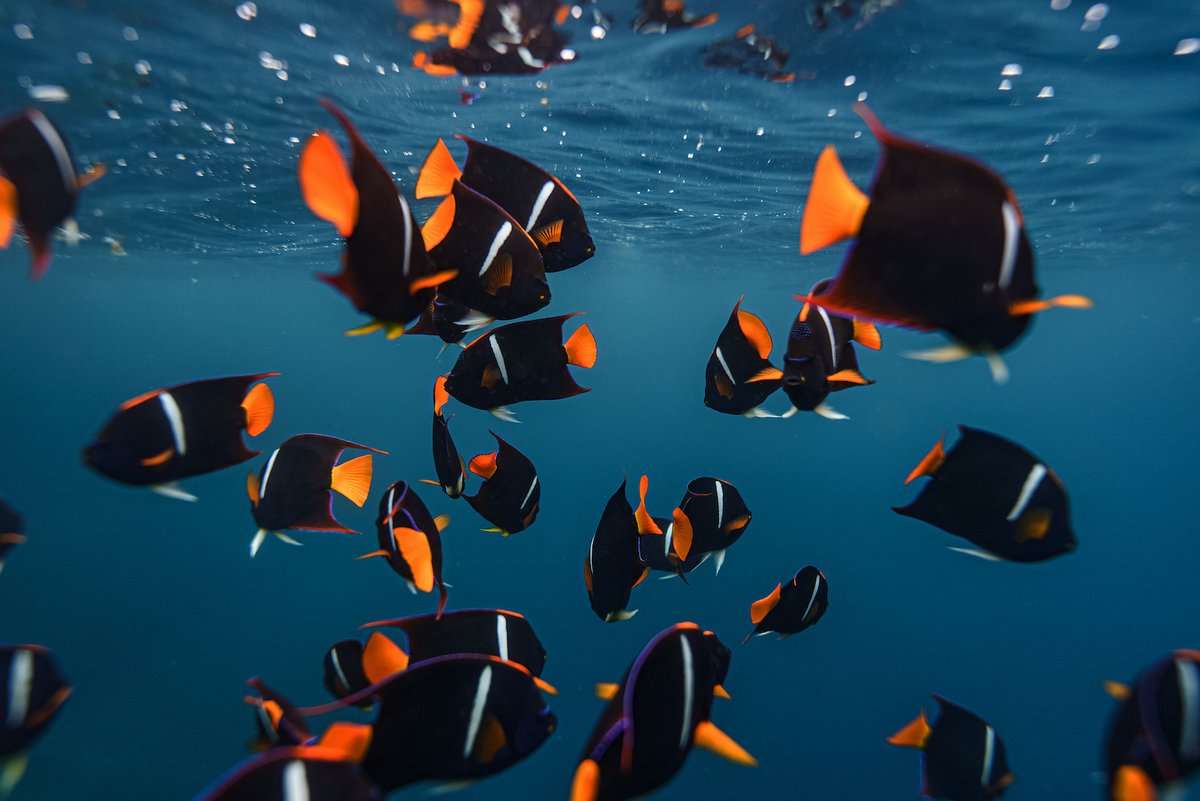
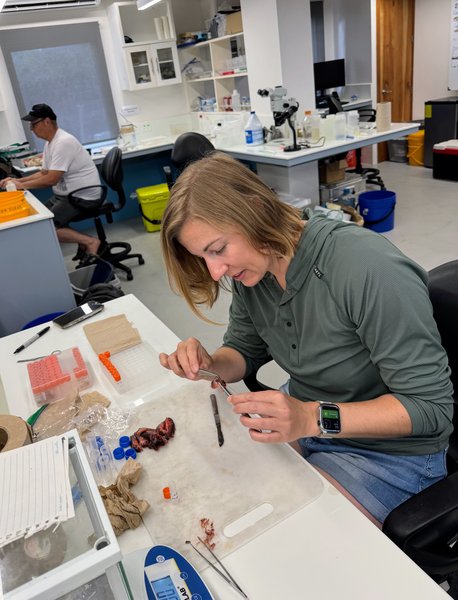
As a marine ecologist, some of my most memorable days were spent diving with Dr. Robert Lamb and Dr. Jon Witman to conduct coral surveys and collect blacktip cardinalfish (Apogon atradorsatus). These fish are endemic to the eastern Pacific oceanic islands of Cocos, Malpelo, and the Galápagos Islands. The fish are found at almost every dive site in Galápagos and therefore can provide insight into how large-scale temperature and nutrient gradients shape marine ecology of Galápagos reefs. Experiencing first-hand the differences between dive sites, each with its own character and community, was both professionally valuable and personally awe-inspiring. Back in the lab, I got to dust off my fish dissection skills and help extract otoliths (ear stones) from the cardinalfish as well as archive fin clips and photographs for further analysis.
Miriam San José
Sharing and Learning
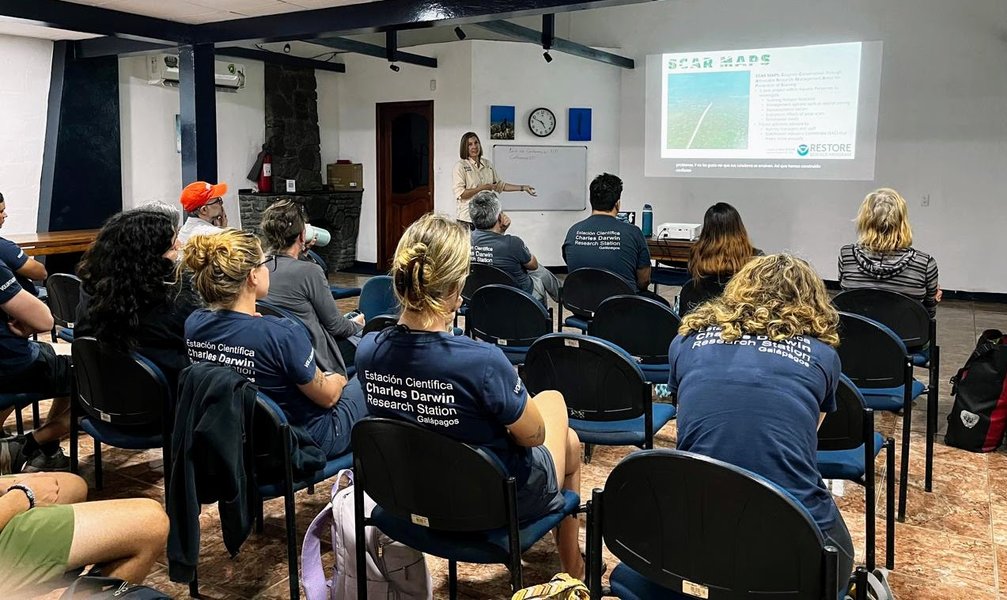
Beyond fieldwork, I had opportunities to present and connect. I gave a seminar to CDF staff and volunteers about my work back in Florida with citizen science and collaborations with resource managers. I attended educational events like the CDF and Galápagos National Park Directorate Open Houses, learned from my labmates’ seminars on insect populations in Scalesia forests, got to tour CDF’s invertebrate collections, and participated in the Galápagos Research and Conservation Symposium on San Cristóbal. Each moment offered new knowledge and a stronger sense of connection to the broader conservation community here.
Reflections on a Special Place
From my first day at CDF, I felt welcomed and valued. It was deeply meaningful to work under the guidance of Dr. Heinke Jäger: an accomplished ecologist whose pioneering research since 1998 has illuminated the complex interactions between invasive and endemic species in the Galápagos. As a strong female leader in science, she leads by example with intellectual rigor, curiosity, and generosity of spirit, creating a collaborative environment where everyone can contribute. I was continually inspired by the breadth of work happening under her direction and by her vision for restoring fragile island ecosystems, even in the face of vast environmental challenges.
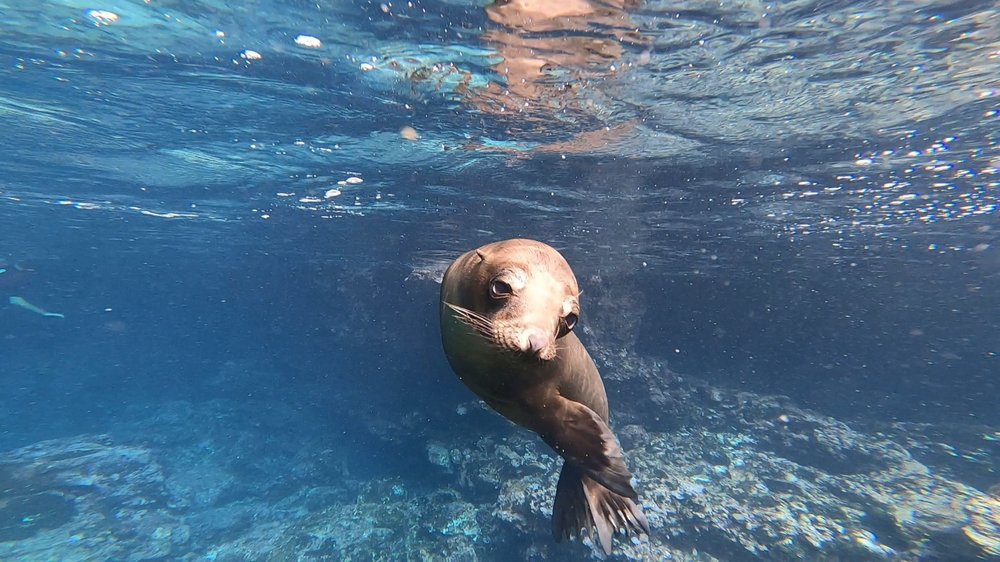
My time here was a tapestry of science, learning, and wonder and often punctuated by close encounters with iconic wildlife and unique plant species, and enriched by learning new field and lab techniques. But alongside the beauty, I became more aware of the challenges facing Galápagos ecosystems. Population growth, climate‑driven changes in ocean currents, invasive species outbreaks, marine debris, and rising sea temperatures all threaten the resilience of these ecosystems. Even here, the crucible of evolutionary science, the fingerprints of human influence are undeniable and increasing.
And yet, I leave encouraged. The dedication of CDF scientists, Galápagos National Park Directorate staff, and so many committed partners is powerful. They are working tirelessly to safeguard the extraordinary biodiversity of these islands. It is thanks to everyone working here that species are being saved from extinction, ensuring the integrity of this UNESCO World Heritage site. To have been a part of this effort, even briefly, is something I am deeply grateful for and I hope I will have another opportunity in the future to support this work.