The Ministry of Environment of Panama and the Charles Darwin Foundation Sign a MOU to protect the scalloped hammerhead shark populations migrating within the Eastern Tropical Pacific
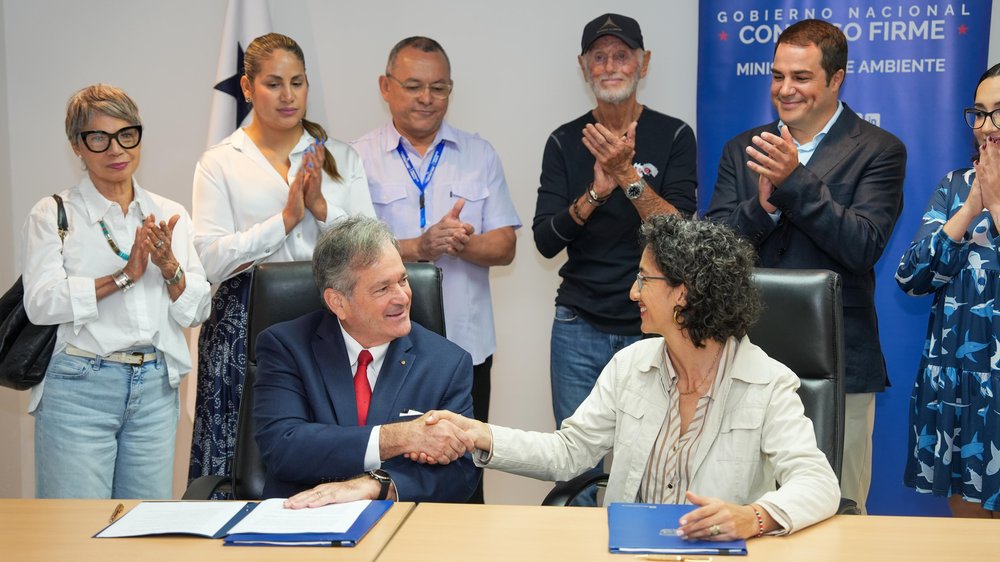
19 May 2026 | Panama City, Panama - The Ministry of Environment of Panama (MiAMBIENTE) and the Charles Darwin Foundation for the Galapagos Islands (CDF) today signed a Memorandum of Understanding (MOU) to strengthen the transboundary protection of the migratory scalloped hammerhead shark (Sphyrna lewini) and advance the recovery of their populations within the Eastern Tropical Pacific (ETP).
A partnership bridging the Science-Policy Interface
The MOU formalises a cooperation framework between the two institutions in applied science, technical support, and strategic communication. It comes directly out of a meeting on the side-lines of the fifteenth Conference of the Parties to the Convention on Migratory Species (CMS COP15) in Campo Grande, Brazil, where CDF and MiAMBIENTE officials identified a shared interest in jointly addressing the conservation crisis facing the Critically Endangered scalloped hammerhead.
The Minister of Environment of Panama, Juan Carlos Navarro Q., stated: “This agreement opens that door and reflects the intention to consolidate technical and scientific collaboration that strengthens the transboundary protection of the scalloped hammerhead shark (Sphyrna lewini), as well as the conservation of the ecosystems and species of the Eastern Tropical Pacific that we protect through the Eastern Tropical Pacific Marine Corridor (CMAR).’ He also added: ‘This effort will provide technical and scientific support for the design and implementation of an updated regulatory framework for sharks and rays in Panama, a priority issue in which we have made significant progress, but where important challenges still remain. Likewise, the technical, operational, and management capacities of both parties will be strengthened, promoting strategic communication mechanisms and innovative blue financing to facilitate the transition toward sustainable practices.”
Pelayo Salinas/CDF
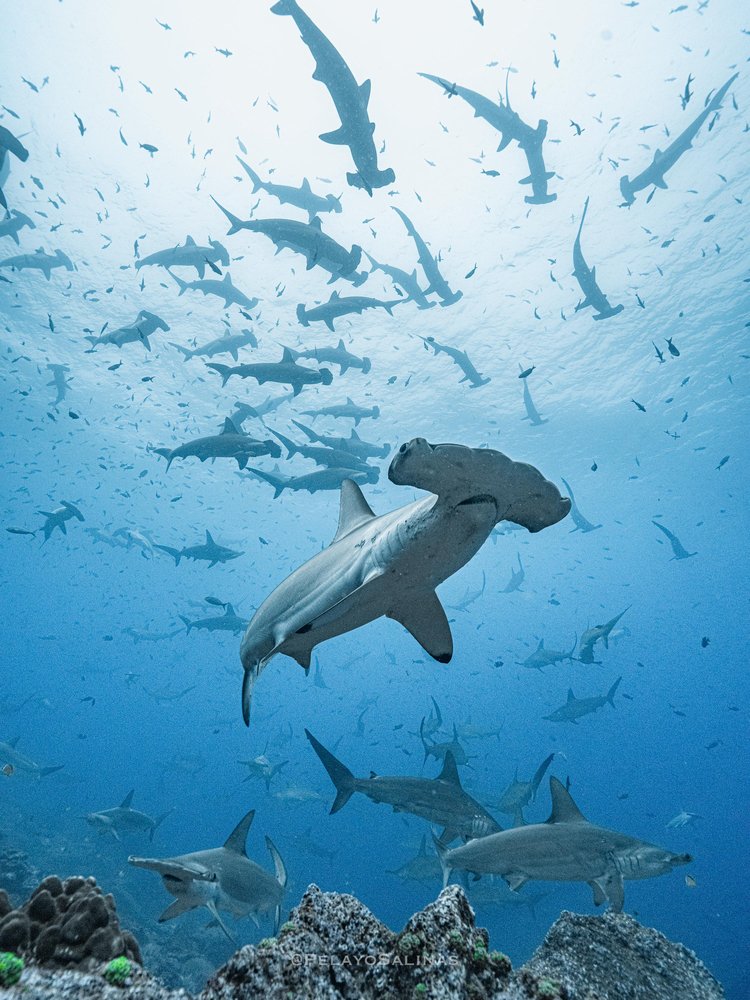
CDF’s applied research has documented that Sphyrna lewini populations undertake predictable and cyclical transboundary migrations connecting the Galapagos Islands with coastal nursery areas in Panama. “The scientific case is unambiguous. These Panamanian waters are of critical importance for the species' survival, serving as critical birthing grounds for pregnant sharks during their annual reproductive migrations and as essential nursery habitat for juveniles during the first years of their lives. Safeguarding ecological connectivity along this transboundary migratory corridor is imperative,” says Dr. Pelayo Salinas de León, co-PI of CDF’s shark ecology and conservation program.
For her part, Digna Barsallo, National Director of Coasts and Seas at MiAMBIENTE and CMAR technical focal point, noted that "this partnership marks a turning point, as pressures on elasmobranch populations remain high precisely within this corridor. Through this agreement, Panama and the CDF are combining capacities to help reverse this trend based on solid scientific evidence and in coordination with the other countries of the region.”
The scalloped hammerhead is currently listed as Critically Endangered on the IUCN Red List based on an estimated >80% global population decline in the last three generations. At CMS COP15, the species was included in Appendix I of the Convention— the highest level of international protection for migratory species underscoring the global urgency of coordinated action - following an up listing proposal led by the government of Ecuador and informed by years of CDF satellite tracking data.
What the MOU Delivers
Under the agreement, the two institutions will collaborate across three interconnected workstreams:
- Technical cooperation and capacity building, including scientific and technical support for the updated shark and ray regulatory framework currently before Panama's National Assembly, comparative legislation analysis, the design of Marine Protected Areas and Other Effective Area-Based Conservation Measures, and annual capacity-building training for MiAMBIENTE staff.
- Strategic communications, translating scientific findings into accessible, audience-specific narratives for legislators, fishing communities, media, and the global conservation community, including the development of a documentary film to be showcased at the IUCN World Conservation Congress in Panama in 2027.
- Regenerative blue economy solutions, exploring innovative funding mechanisms to support the voluntary transition of artisanal fishers toward non-extractive livelihoods compatible with Panama’s obligations with the WTO Agreement on Fisheries Subsidies.
“Our decade-long studies on the movement ecology of scalloped hammerhead sharks have shown the value of applied research to inform the international conservation of highly migratory species, highlighting the critical importance of nursery areas located in Panama for the recovery of this Critically Endangered species.” Said Dr. María José Barragán Paladines, Science Director of the CDF. “We look forward to working with MiAmbiente and other local and regional stakeholders in this urgent mission to save hammerheads from extinction.”
The MOU will operate aligned with the framework of the Eastern Tropical Pacific Marine Conservation Corridor (CMAR), the regional alliance uniting the Cocos, Galapagos, Malpelo, Gorgona, and Coiba island ecosystems and marine protected areas, established by the San José Declaration in 2004.
This applied research and international policy for the conservation work has been kindly supported by the Mark Rohr Foundation, the Save Our Seas Foundation, the Darwin and Wolf Conservation Fund, Rolex Perpetual Planet and MAC3 Impact Philanthropies.
--ENDS--
Notes to editors:
For media enquiries please contact:
Charles Darwin Foundation
Ambre Tanty-Lamothe or Daniela Ibarra | comunicacion@fcdarwin.org.ec
About the Charles Darwin Foundation
The Charles Darwin Foundation for the Galápagos Islands (CDF) is an international non-profit organization that has operated in Galápagos since 1959 under a special agreement with the Government of Ecuador. Its mission, and that of its Research Station, is to address the greatest threats and challenges facing Galápagos through scientific research and conservation actions, to protect one of the world’s most important natural treasures. Today CDF supports more than 25 research, conservation, and education projects across land and sea, and is the custodian of over 137,000 specimens in its Natural History Collections. Its diverse team of more than 140 scientists, educators, and support staff is composed primarily of Ecuadorian citizens, with over 60 % from Galápagos. For more information, please visit: www.darwinfoundation.org